
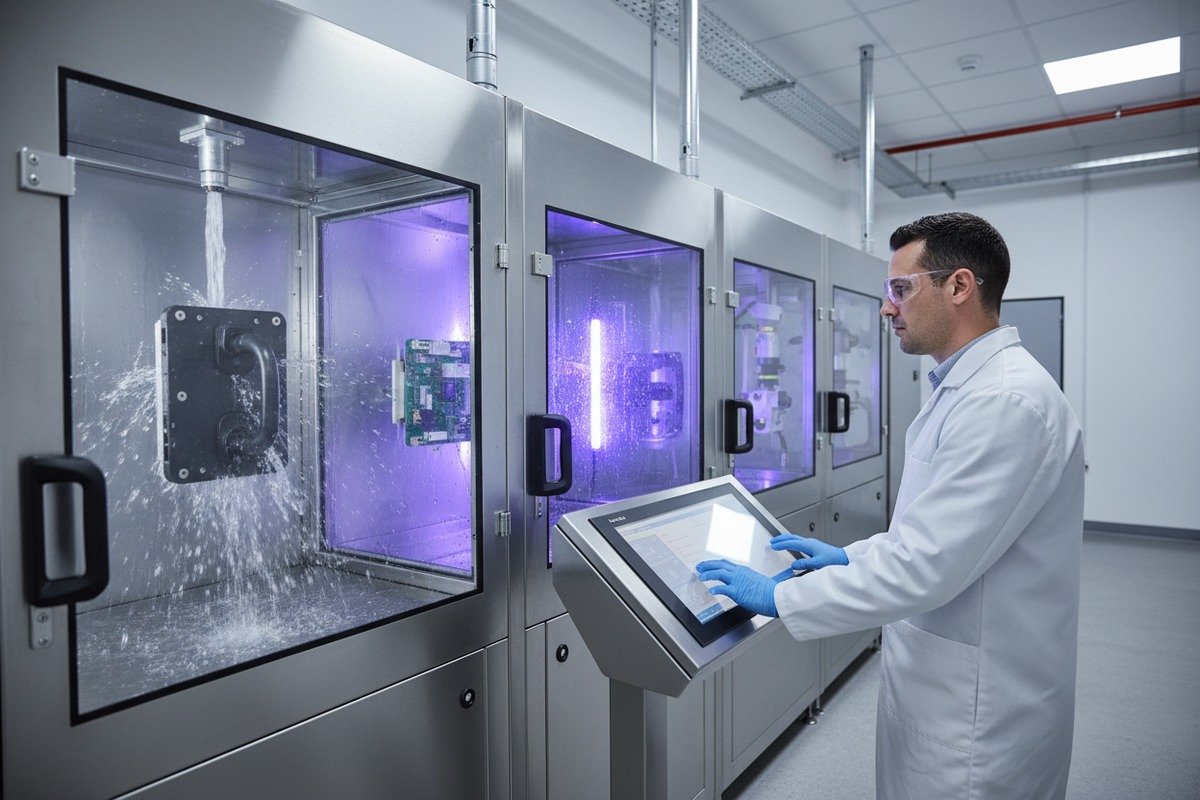
Every year, we see returned locks from outdoor solar installations that cracked, jammed, or corroded far earlier than expected IP66/NEMA 4X ingress testing 1. These failures cost our clients thousands in battery damage and downtime. Understanding how to properly test cabinet door locks before deployment is what separates reliable energy storage systems from expensive headaches.
To test solar PV energy storage cabinet door lock weather resistance and lifespan, you should conduct IP66/NEMA 4X ingress testing, salt spray corrosion tests per ASTM B117, UV exposure trials per ISO 4892, thermal cycling from -40°C to 85°C, and accelerated mechanical endurance cycling of 10,000 to 50,000 operations.
Below, we break down each critical test area so you can confidently select, verify, and future-proof the locks and latches on your outdoor energy storage cabinets salt spray corrosion tests per ASTM B117 2. Let's start with the standards that matter most.
What standards should I look for to ensure my PV cabinet locks meet NEMA 4X or IP66 requirements?
One of the most common questions we hear from procurement teams in North America is which exact certifications to demand on a purchase order UV exposure trials per ISO 4892 3. Without clarity here, you risk installing hardware that fails its first rainy season.
Look for locks tested to IEC 60529 for IP66 ratings and UL 50E for NEMA 4X enclosures. These standards define dust-tight and powerful water jet resistance. Ensure your supplier provides third-party test reports, not just self-declared ratings, to guarantee genuine compliance.
Understanding IP66 vs. NEMA 4X
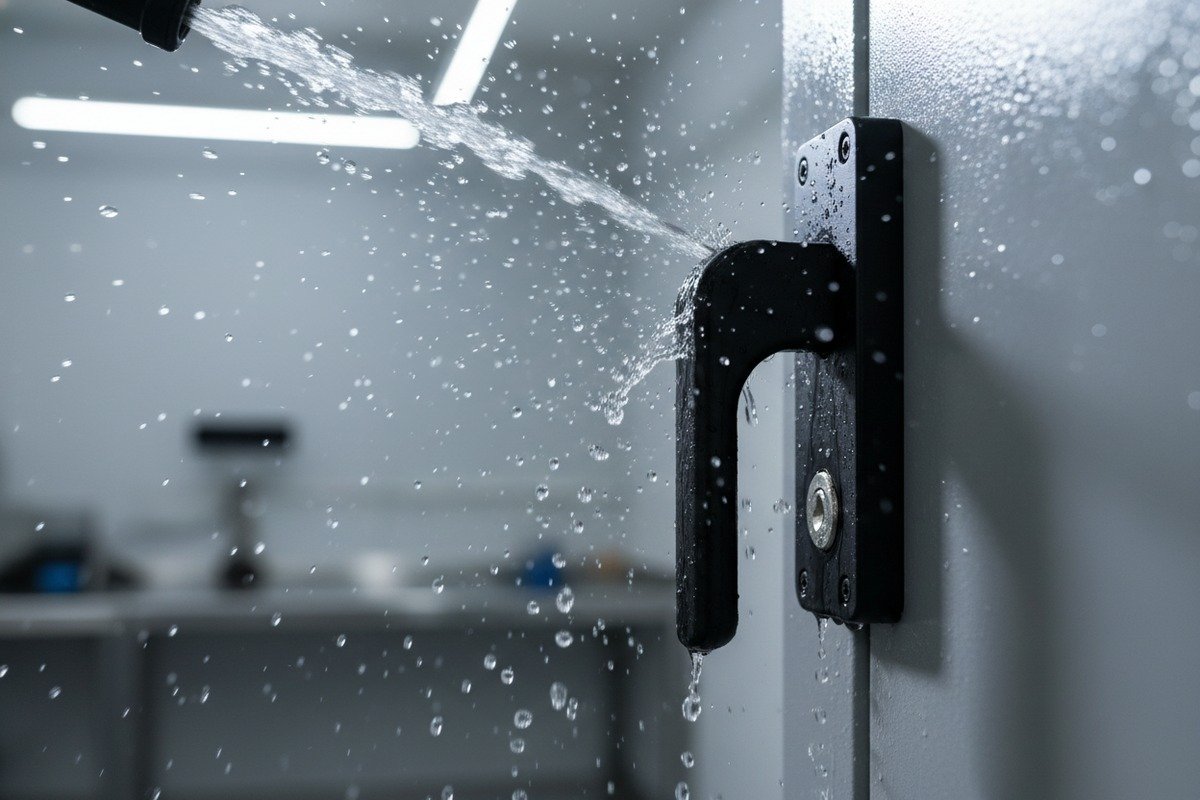
Many buyers use IP66 and NEMA 4X interchangeably. They overlap, but they are not identical. IP66 is an international standard under IEC 60529 IEC 60529 for IP66 ratings 4. It tests dust ingress and water jet resistance. NEMA 4X, governed by UL 50E in North America, goes further UL 50E for NEMA 4X enclosures 5. It also covers corrosion resistance and external ice formation. If your cabinets will be deployed in coastal or cold climates, NEMA 4X is the stronger requirement Finite Element Analysis (FEA) 6.
When we design locks for energy storage OEMs, we always recommend testing against both. This dual approach covers the broadest range of field conditions. Our in-house lab runs IEC 60529 water jet tests at 12.5 liters per minute from 2.5 to 3 meters distance. Then we run the additional NEMA 4X corrosion protocol. This way, we can issue reports that satisfy both European and American certification bodies.
Key Tests Within These Standards
Here is a breakdown of the core tests involved:
| Test | Standard | Procedure | Pass Criteria |
|---|---|---|---|
| Dust Ingress | IEC 60529 (IP6X) | 8-hour exposure in dust chamber with negative pressure | No dust penetration into enclosure |
| Water Jet | IEC 60529 (IPX6) | 12.5 L/min jet from 100mm nozzle, 3 min per side | No water ingress affecting function |
| Corrosion Resistance | UL 50E (NEMA 4X) | 200-hour salt spray per ASTM B117 | No functional degradation or red rust |
| External Icing | UL 50E (NEMA 4X) | Ice formation at -18°C, then operation test | Lock must still open and close |
What to Demand from Your Supplier
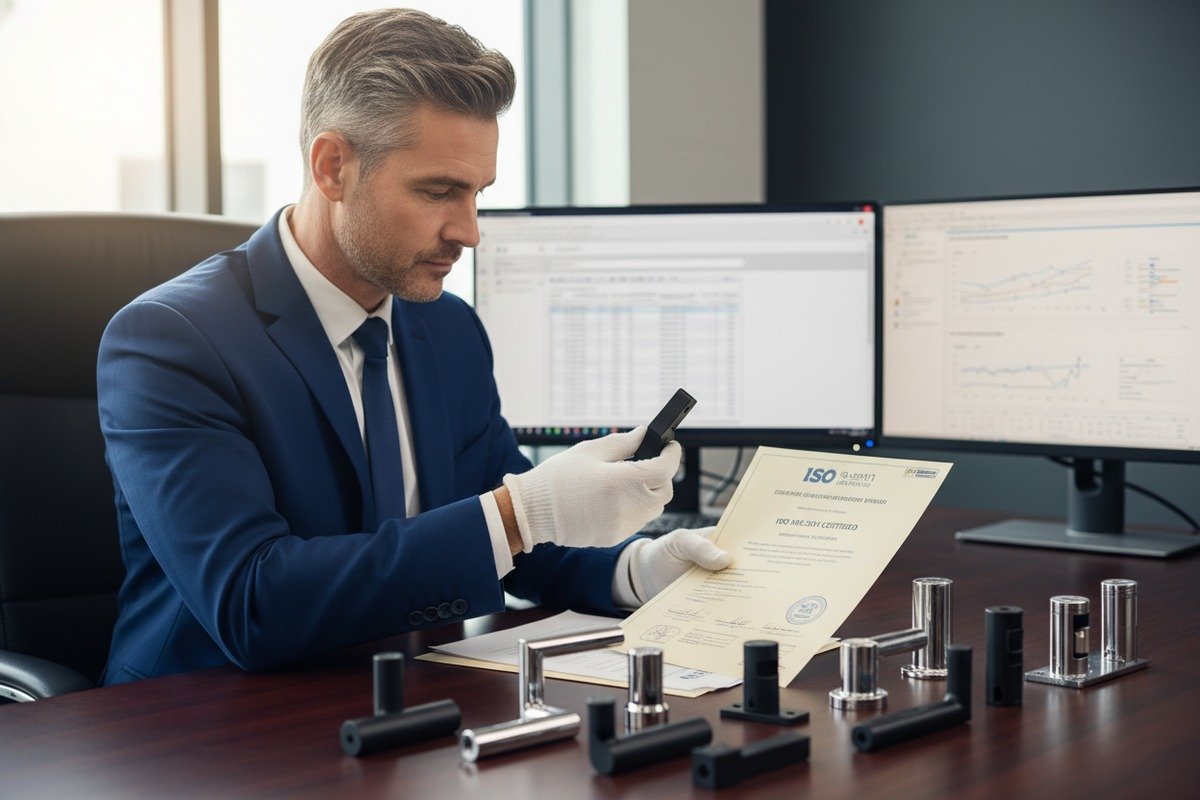
Do not accept a simple "IP66" stamp on a product page. Ask for the actual test report. A credible report will include the testing lab's accreditation number, the exact IEC or UL clause tested, the date, and photographic evidence. At our facility, we provide full test documentation with every batch, because we know our clients need this for their own UL or CE filings.
Also, pay attention to gasket material. Silicone and EPDM gaskets maintain sealing performance across wide temperature ranges. Cheap rubber degrades under UV, breaking the seal within two to three years. We use silicone gaskets rated for -50°C to 200°C on all our outdoor-rated cam latches and swing handles.
How can I verify that my energy storage cabinet hardware will resist corrosion in high-UV outdoor environments?
Over the past decade, our engineering team has tracked field failures across installations in the American Southwest, the Middle East, and coastal Australia. The number one killer is not water. It is the combination of UV radiation and salt-laden air attacking lock surfaces simultaneously.
Verify corrosion and UV resistance by requiring salt spray testing per ASTM B117 (minimum 500 hours for coastal use), UV aging per ISO 4892-2 (1,000+ hours of xenon arc exposure), and material certifications for 304 or 316 stainless steel. Third-party lab reports confirm real-world durability.
Salt Spray Testing Explained
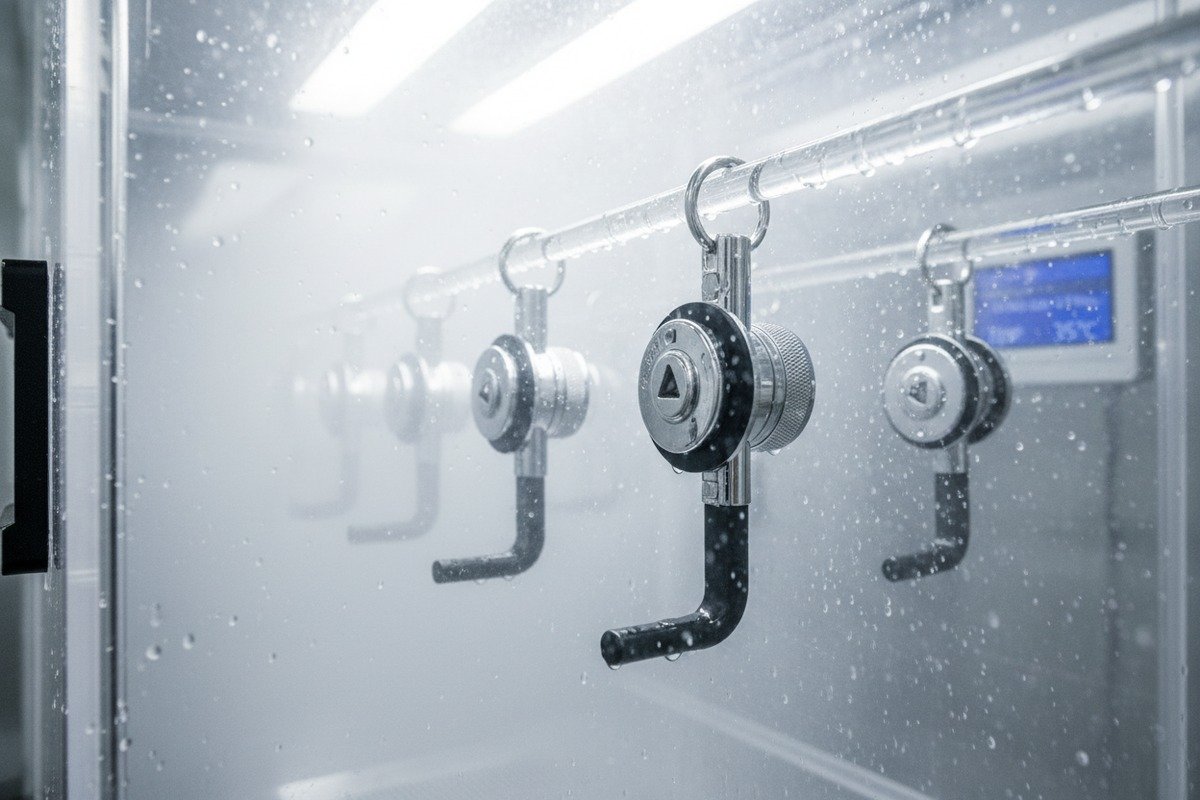
Salt spray testing, also called salt fog testing, is the industry standard for corrosion evaluation. The lock or latch sits in a sealed chamber while a 5% sodium chloride solution is atomized at 35°C. The test runs continuously for a set number of hours.
Here is how exposure hours relate to real-world conditions:
| Salt Spray Hours | Approximate Real-World Equivalent | Recommended Application |
|---|---|---|
| 48 hours | Light indoor/sheltered outdoor | Warehouse cabinets |
| 200 hours | Mild outdoor, inland | Rural solar farms |
| 500 hours | Moderate outdoor, some coastal influence | Suburban installations |
| 1,000 hours | Severe coastal or industrial atmosphere | Coastal PV plants, offshore-adjacent |
We run 500-hour salt spray as our baseline for all stainless steel locks. For 316L stainless steel products destined for coastal energy storage projects, we push to 1,000 hours. After testing, we inspect for red rust, white rust on zinc layers, and any mechanical degradation of the locking mechanism.
UV Aging Protocol
UV radiation breaks down polymers, fades finishes, and embrittles plastic components. ISO 4892-2 uses a xenon arc lamp to simulate sunlight. The test cycles between UV exposure and condensation to mimic day-night transitions. After 1,000 hours, which roughly simulates 3 to 5 years of Arizona sun, we inspect for cracking, chalking, color change, and loss of mechanical grip on the latch.
For our matte black powder-coated cam latches, we also measure gloss retention and adhesion after UV exposure. A well-formulated outdoor powder coat should retain at least 80% gloss after 1,000 hours. Our coatings consistently exceed this benchmark, which is why several major US enclosure brands specify them for their solar product lines.
Material Selection Matters
Beyond testing, the base material is your first line of defense. Zinc alloy with chromate conversion is acceptable for indoor use, but outdoor solar demands more. We recommend:
- 304 Stainless Steel: Good all-round corrosion resistance. Suitable for inland and mild coastal.
- 316 Stainless Steel: Contains molybdenum for superior chloride resistance. Essential for marine and heavily polluted environments.
- Powder-Coated Zinc Alloy: Cost-effective when using UV-stable polyester powder coats rated to 2,000+ hours of salt spray. A good middle ground for budget-sensitive projects.
When evaluating a supplier, ask for the material test certificate (MTC) for every metal component. This document traces the alloy composition back to the mill. Without it, you are trusting a label, not a fact.
What is the best way to simulate a 20-year lifespan for my industrial cabinet hinges and latches?
When our R&D team sits down to validate a new hinge or latch design, the first question is always the same: will this still work perfectly after two decades in the field? You cannot wait 20 years to find out. You need accelerated life testing.
The best way to simulate a 20-year lifespan is to combine accelerated mechanical cycling (50,000+ open-close operations), thermal cycling from -40°C to 85°C for 200+ cycles, Highly Accelerated Life Testing (HALT), and sustained vibration testing per IEC 60068-2-6. These compressed protocols reveal failure modes that would take decades in the field.
Mechanical Endurance Cycling
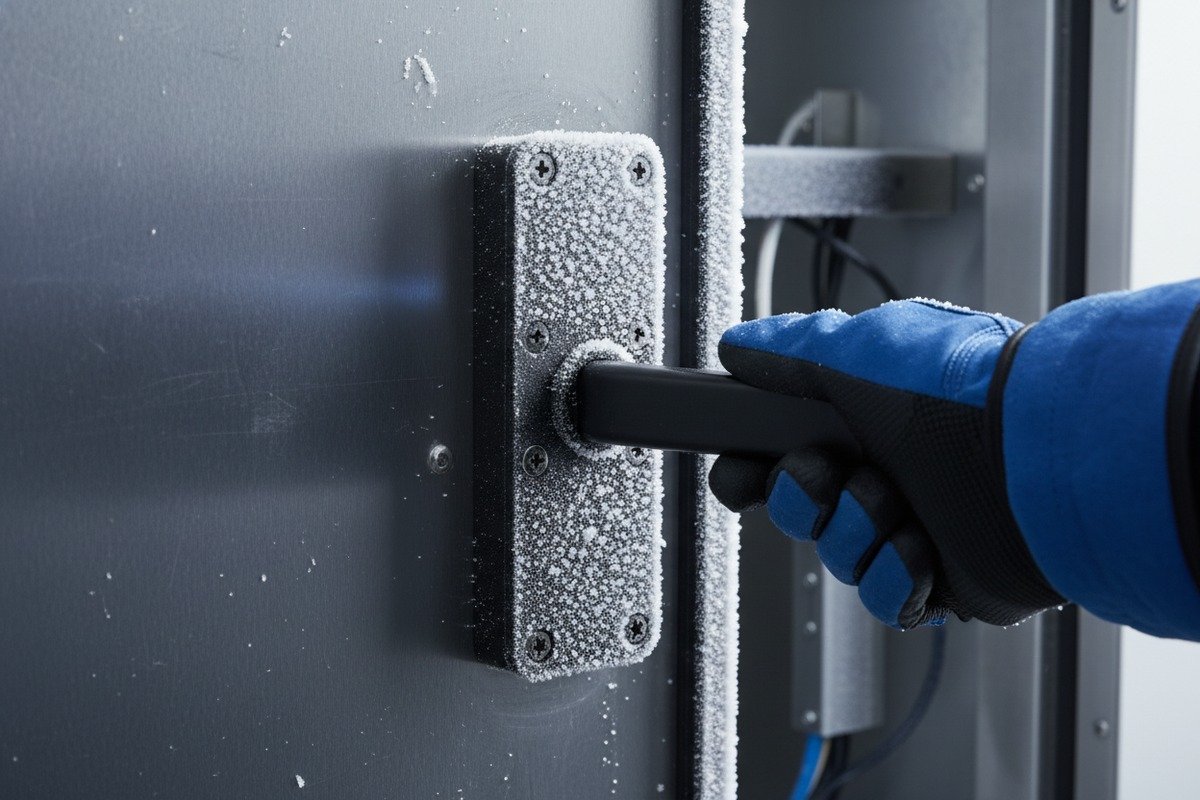
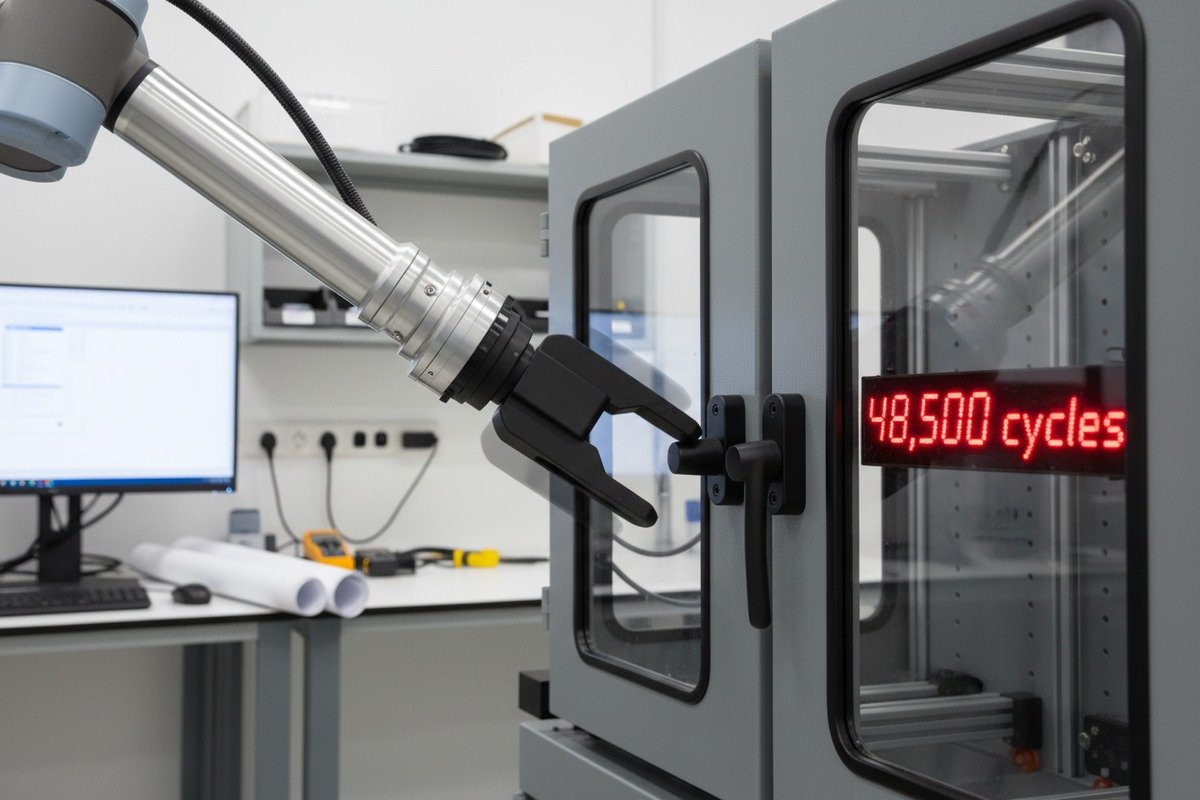
This is the most straightforward test. A pneumatic or motorized fixture opens and closes the latch or hinge thousands of times under controlled load. For energy storage cabinets, maintenance crews typically open doors several times per year. But we factor in commissioning, inspections, emergency access, and component swaps. Over 20 years, a realistic count is 2,000 to 5,000 cycles. So why do we test to 50,000? Because accelerated cycling at higher speeds introduces fatigue stresses that approximate decades of slower, real-world use plus environmental degradation.
We document torque at every 5,000-cycle interval. If the latch engagement force drifts more than 15% from baseline, we flag the design for review. This has caught subtle tooling issues that would have led to field failures years later.
Thermal Cycling and HALT
Thermal cycling 8 tests the expansion and contraction of different materials bonded or fastened together. Zinc alloy, stainless steel, silicone gaskets, and nylon inserts all expand at different rates. Over hundreds of hot-cold cycles, these mismatches create micro-gaps that lead to loosening or seal failure.
Our standard protocol cycles from -40°C to 85°C with 30-minute dwell times at each extreme. We run at least 200 cycles. After the test, we re-check IP rating, mechanical operation, and gasket compression set.
HALT goes even further. It pushes the product beyond its design limits to find the weakest link. We ramp temperature from -60°C to 100°C while simultaneously applying multi-axis vibration at increasing intensity. The goal is not to pass—it is to break the product and then improve it.
Vibration and Shock
Solar farms experience wind-induced vibration. Energy storage containers on transport trucks endure severe road shock. IEC 60068-2-6 defines sinusoidal vibration testing from 5 Hz to 55 Hz. IEC 60068-2-27 covers mechanical shock. We mount locks on a vibration table and run both tests sequentially.
| Test | Standard | Parameters | Duration | Pass Criteria |
|---|---|---|---|---|
| Sinusoidal Vibration | IEC 60068-2-6 | 5–55 Hz, 0.35 mm amplitude | 2 hours per axis (X, Y, Z) | No loosening, no rattle, full function |
| Mechanical Shock | IEC 60068-2-27 | 15g peak, 11 ms half-sine pulse | 3 shocks per direction, 6 directions | No fracture, latch still engages |
| Thermal Cycling | IEC 60068-2-14 | -40°C to 85°C, 30-min dwell | 200 cycles | IP rating maintained, no seal gap |
| Mechanical Endurance | Internal Protocol | Open/close under 5 Nm load | 50,000 cycles | Torque drift < 15% |
Using Arrhenius Modeling
For temperature-related degradation of seals and coatings, the Arrhenius equation 9 lets us calculate equivalent aging. By testing at elevated temperatures (e.g., 70°C continuous), we can compress years of 25°C ambient aging into weeks. This model is well-established in polymer science and gives us confidence in our gasket life predictions. We pair Arrhenius results with the mechanical data to create a composite lifespan estimate. When our engineers present these combined datasets to clients, it builds the kind of trust that turns a first order into a long-term partnership.
How do I find a manufacturer that offers certified test reports and CAD designs for my custom lock projects?
Sourcing industrial hardware from overseas can feel like a gamble when you cannot physically inspect every batch. Our clients in the US and Europe tell us that the two things that eliminate uncertainty fastest are certified test documentation and ready-to-integrate CAD files.
Find a manufacturer that holds UL, TUV, or IAPMO certifications, operates 35+ in-house testing devices, and provides free CAD design services in STEP or IGES formats. Request sample test reports before ordering. A credible supplier will share these openly, not hide behind vague product claims.
What Certifications Actually Matter
Not all certifications carry equal weight. For the North American market, UL listing is the gold standard for enclosure hardware. TUV is widely recognized in Europe. IAPMO certification covers plumbing and mechanical codes but also validates manufacturing quality systems relevant to hardware. When a factory holds all three, it signals investment in consistent quality across multiple regulatory frameworks.
At our Xi'an facility, we maintain UL, TUV, and IAPMO certifications. We also keep 35+ dedicated testing devices in-house—salt spray chambers, UV aging equipment, tensile testers, vibration tables, and IP testing rigs. This means we do not outsource critical tests and we can re-run them anytime a client requests verification.
Evaluating a Supplier's Testing Capability
Here is a checklist to use when vetting potential manufacturers:
| Evaluation Criteria | What to Ask For | Red Flag If Missing |
|---|---|---|
| Third-party certifications | UL, TUV, IAPMO certificates with valid dates | Only self-declared ratings |
| In-house test equipment | Photos or video of lab; equipment list | "We send samples to an external lab" with no details |
| Test report samples | Actual PDF reports from previous projects (redacted if needed) | Refusal to share any documentation |
| CAD design capability | STEP, IGES, or SolidWorks files; free design iteration | Only 2D drawings or no design support |
| Material traceability | Mill test certificates for stainless steel, alloy composition | "We use standard material" with no MTC |
| Lead time transparency | 15–35 day production timeline with milestone updates | Vague "4–8 weeks" with no tracking |
The Value of Free CAD Services
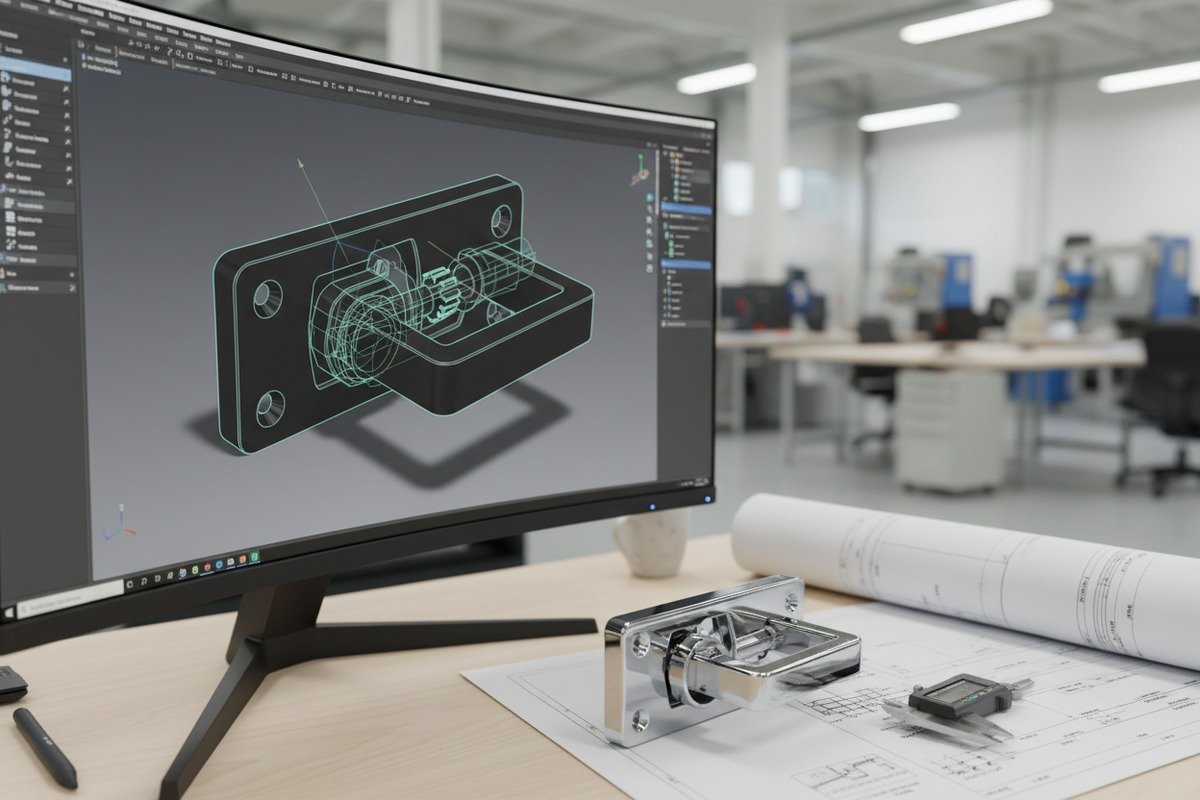
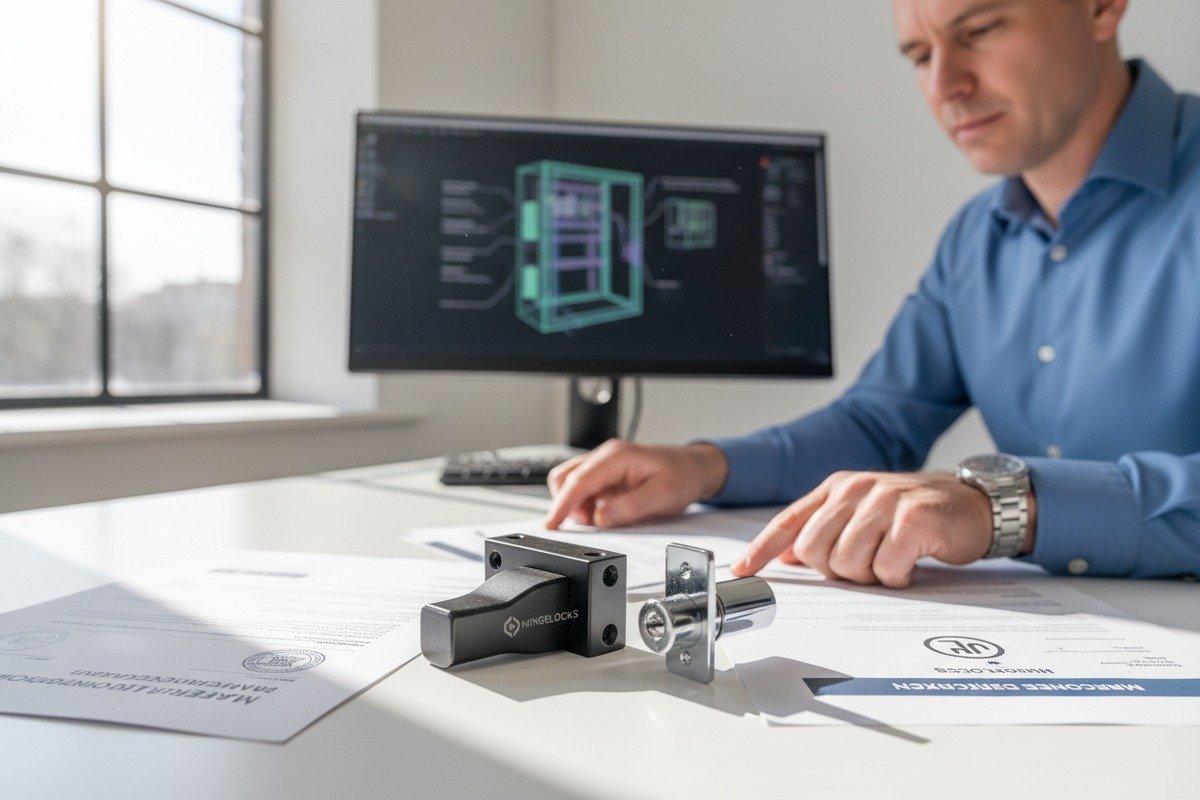
When you are integrating a custom lock into a new cabinet design, CAD compatibility is not a luxury. It is a necessity. Your mechanical engineers need 3D models to check fit, clearance, and interference before tooling begins. Mistakes caught in CAD cost nothing. Mistakes caught after tooling cost thousands.
We provide free CAD design services for every custom project. Our engineering team works in SolidWorks and exports to STEP, IGES, and Parasolid formats. We typically deliver initial 3D models within 3 to 5 business days. For complex multi-point latching systems, we also run FEA (Finite Element Analysis) to verify stress distribution under load. This level of pre-production support is what separates a component supplier from a true engineering partner.
Small Batch Flexibility
Many energy storage startups and EV charger companies need small initial runs—100 to 500 pieces—to validate their cabinet design before scaling. Large factories often refuse small orders or charge prohibitive setup fees. We support small-batch OEM/ODM orders with the same quality controls applied to our large production runs. This lets our clients test the market with real products instead of waiting months to hit minimum order quantities.
When evaluating any manufacturer, ask specifically about their MOQ policy and whether small-batch pricing is available. Also ask if they will hold your custom tooling for future reorders at no additional storage cost. These details matter more than most buyers realize at the outset of a project.
Conclusion
Testing weather resistance and lifespan for solar PV cabinet locks requires a systematic approach combining IP/NEMA ingress tests, corrosion and UV protocols, accelerated life cycling, and verified certifications from a capable manufacturer.
Footnotes
1. Found a comprehensive comparison of IP66 and NEMA 4X ratings. ↩︎
2. Explains the ASTM B117 standard for salt spray corrosion testing. ↩︎
3. Explains ISO 4892-2 for UV weathering using xenon-arc lamps. ↩︎
4. Official IEC page explaining the Ingress Protection (IP) Code. ↩︎
5. Explains UL 50E standard for electrical equipment enclosures, including NEMA 4X. ↩︎
6. Explains FEA as a simulation technique for engineering design and optimization. ↩︎
7. Found a detailed article on the properties and applications of 316 Stainless Steel from an authoritative materials science website. ↩︎
8. Provides a general definition and purpose of thermal cycling in reliability testing. ↩︎
9. Explains the Arrhenius equation's application in reliability engineering and accelerated life testing. ↩︎
10. Provides a comprehensive definition and overview of HALT methodology. ↩︎



 Thai
Thai  English
  Spanish
  French
  German
  Japanese
  Arabic
  Korean
  Swedish
  Dutch
Dutch  Greek
Greek  Hindi
Hindi  Hebrew
  Italian
  Vietnamese
  Bulgarian
  Czech
Czech  Slovak
  Hungarian
  Finnish