
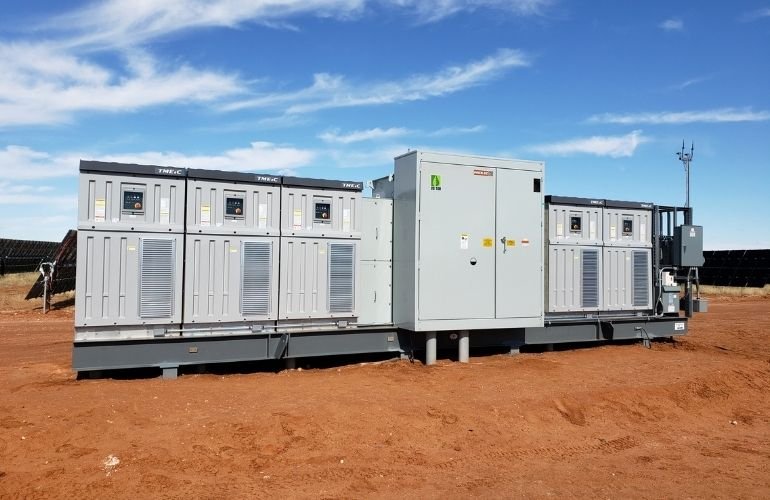
Photovoltaic (PV) inverters are the heart of any solar power plant. Often located in vast, unshaded fields or atop commercial rooftops, these units are subjected to some of the harshest environmental conditions on Earth. While much focus is placed on the efficiency of the semiconductors inside, the mechanical hardware—specifically the locks and hinges—is what keeps the system protected.
In solar applications, the two silent killers of enclosure hardware are Ultraviolet (UV) Radiation and Extreme Heat. Here is how to ensure your inverter cabinets remain secure for their 25-year expected lifespan.
1. The UV Challenge: Preventing "Polymer Breakdown"
Standard industrial plastics and low-quality coatings suffer from a process called Photo-oxidation when exposed to constant sunlight.
- The Symptom: You may notice handles becoming "chalky," brittle, or changing color (yellowing) after just 12 months in the field.
- The Risk: A brittle handle can snap off during routine maintenance, leaving the inverter cabinet inaccessible or, worse, stuck open and exposed to the elements.
The Solution:
For solar applications, non-metallic components must be made from UV-Stabilized Polyamide (PA66). These materials contain specialized additives that absorb or reflect UV rays, maintaining structural flexibility even after decades of sun exposure.
2. Thermal Management: Operating in the "Oven"
Solar inverters generate significant internal heat while sitting in the direct sun. It is common for the internal air temperature of a PV enclosure to exceed 70°C (158°F).
High heat impacts locks in two ways:
- Thermal Expansion: Different materials expand at different rates. If a lock's internal tolerances are too tight, the heat can cause the mechanism to bind or "jam."
- Gasket Degradation: Standard rubber gaskets can dry out, crack, and lose their "spring" in high heat. Once the gasket fails, the IP66 rating is lost, and moisture enters the inverter electronics.
3. Recommended Hardware Materials for Solar Projects
| Material | UV Resistance | Heat Tolerance | Corrosion Protection |
|---|---|---|---|
| 316 Stainless Steel | Perfect | Excellent | Superior (Best for coastal solar) |
| Zinc Alloy + Powder Coat | Good | Moderate | High (Cost-effective for inland) |
| UV-Stabilized Nylon | Excellent | Moderate | Perfect (No rust/non-conductive) |
4. Key Design Features for Solar Inverters
A. High-Compression Latches
Because heat causes gaskets to soften, you need a Compression Latch that can provide a consistent "pull-in" force. This ensures that even as the door expands and contracts throughout the day, the seal remains airtight.
B. Non-Conductive Handles
For safety reasons, many solar OEMs prefer Reinforced Polyamide handles. In the rare event of an internal electrical fault, a non-metallic handle prevents the operator from receiving a "touch-voltage" shock when opening the cabinet.
C. Low-Profile "Aerodynamic" Designs
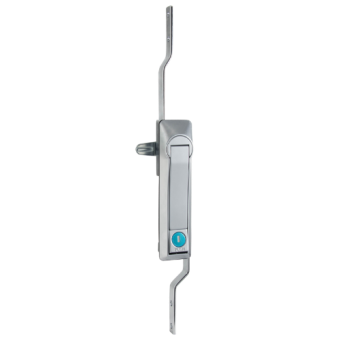
In large-scale solar farms, wind loads can be intense. Low-profile swing handles reduce the surface area for wind to catch, preventing accidental unlatching during high-wind events or storms.
5. Summary: Protecting the ROI of Renewable Energy
A solar inverter is a 20+ year investment. If a $20.00 lock fails due to sun damage, it can lead to a $10,000 inverter replacement or days of lost energy production.
Procurement Checklist for Solar Hardware:
- [ ] Does the plastic meet ISO 4892-2 (UV aging) standards?
- [ ] Is the gasket made of Silicone or EPDM (high-temp resistant)?
- [ ] Has the hardware been tested for operation at +80°C?
- [ ] Does the finish support a C5-M (Marine) corrosion rating for coastal arrays?
Build More Reliable Solar Infrastructure
HingeLocks specializes in "Solar-Grade" hardware. Our MS-series is currently deployed in some of the world's largest PV arrays.


 Vietnamese
  English
  Spanish
  French
  German
  Japanese
  Arabic
  Korean
  Swedish
  Dutch
Dutch  Greek
Greek  Hindi
Hindi  Hebrew
  Italian
  Thai
Thai  Bulgarian
  Czech
Czech  Slovak
  Hungarian
  Finnish