
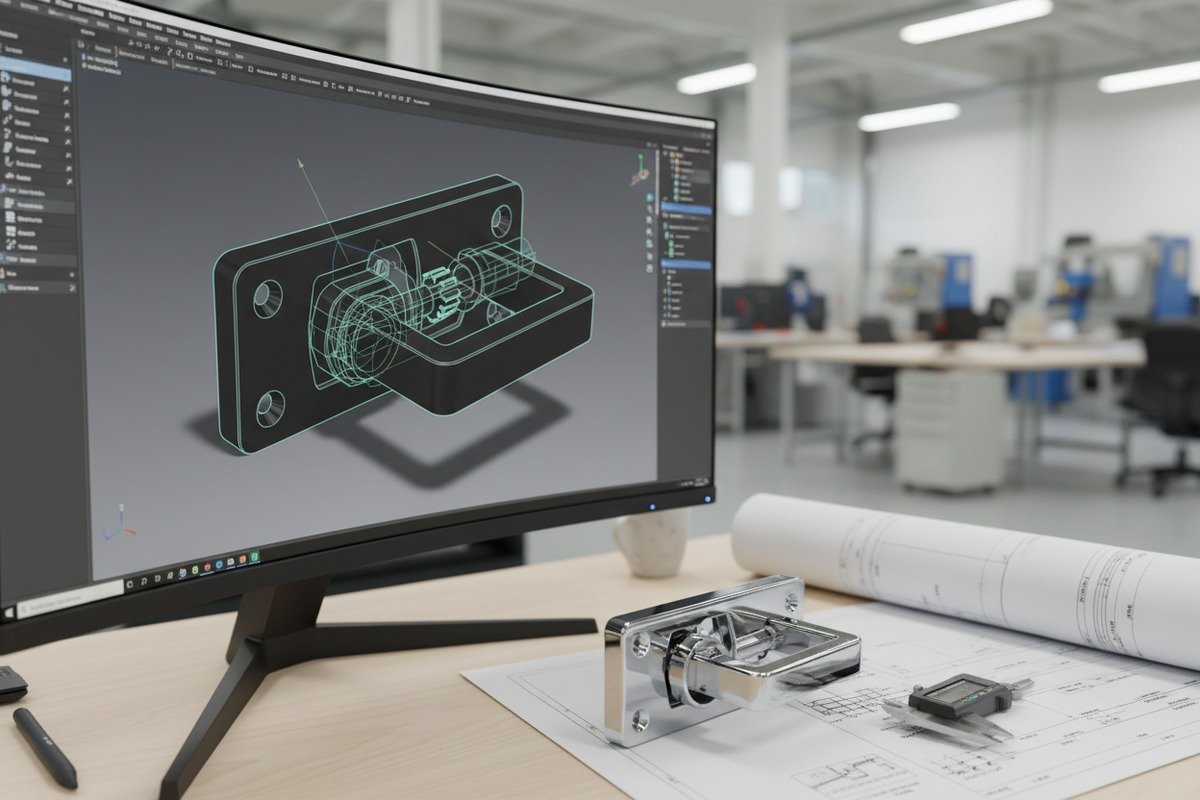
Every year, our production floor handles hundreds of custom cam lock projects, and the number one headache we see from overseas buyers is workflow breakdown — somewhere between the 3D design approval and the moment pallets hit the shipping dock, something goes wrong Design for Manufacturability (DFM) 1. A missed tolerance, a failed IP66 test, a logistics bottleneck. These gaps cost time, money, and trust.
Managing an OEM custom cam lock SOP workflow requires a structured pipeline: validate 3D designs through DFM review and functional prototyping, enforce IP66/NEMA testing at defined checkpoints, standardize every production step with documented SOPs, and coordinate logistics proactively from sample approval through bulk shipment to prevent delays.
This guide walks you through each critical phase functional prototyping 2. Whether you are a procurement manager sourcing cabinet locks or an engineer specifying enclosure hardware, you will find actionable steps below. Let's break it down stage by stage.
How can I ensure my custom 3D cam lock design translates accurately into a functional prototype?
We have seen it too many times on our engineering floor — a beautiful CAD file arrives from a client, but once we start tooling, the design fails at the grip range or the cam geometry interferes with the panel cutout IP66/NEMA testing 3. The gap between digital design and physical reality is where most OEM projects stumble.
To ensure your 3D cam lock design translates accurately into a functional prototype, conduct a Design for Manufacturing (DFM) review before tooling, build a rapid prototype using CNC or 3D printing, and validate critical dimensions — panel thickness, grip range, and cam rotation — against your enclosure specifications.
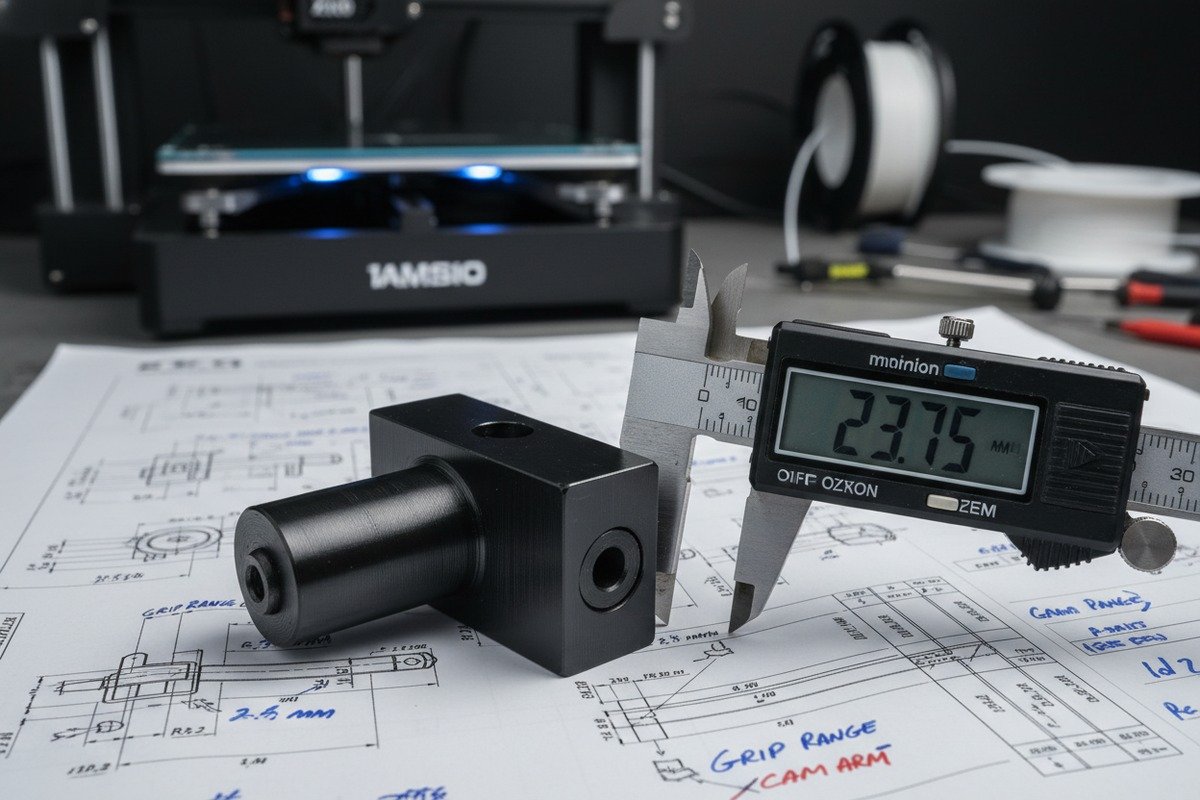
Start With a DFM and DFA Review
Design for Manufacturing (DFM) and Design for Assembly (DFA) 4 reviews are not optional. They are the first real checkpoint. When our R&D team receives a new 3D file, we run it through a structured review that checks for:
- Wall thickness uniformity
- Undercuts that complicate die casting
- Thread feasibility for the chosen material
- Cam arm clearance during 90-degree rotation
This review catches roughly 60–70% of issues before any metal is cut. It saves weeks of back-and-forth later.
Lock Down Your Engineering Constraints First
Before you customize anything — finish, color, branding — you need to fix the non-negotiable parameters. These include panel thickness, grip range, cam geometry, and material grade. Only after these are locked should you explore aesthetic options.
| Engineering Parameter | Why It Matters | Common Mistake |
|---|---|---|
| Panel thickness | Determines body length and thread engagement | Specifying a single thickness when enclosure varies |
| Grip range | Controls clamping force on door/panel | Ignoring gasket compression in the calculation |
| Cam geometry | Defines locking engagement and rotation arc | Using a generic cam profile without testing fit |
| Material grade | Affects corrosion resistance and strength | Choosing zinc alloy where stainless steel is needed |
Use Rapid Prototyping Wisely
Our facility uses both CNC machining 5 and selective 3D printing for prototypes. CNC gives you a metal part that closely mimics production material properties. 3D printing is faster and cheaper for checking form and fit but cannot replicate the mechanical behavior of die-cast zinc alloy or stainless steel.
For functional validation, we always recommend at least one CNC prototype. You need to physically test the cam rotation, confirm the key interface, and verify the lock seats properly in the cutout. A 3D-printed part can fool you — it may fit but fail under load.
Manage Your CAD Files Like Production Assets
Version control matters. We have had projects derailed because a client sent revision 3 of a file while our team was already machining revision 2. Use a clear naming convention. Tag every file with a date and revision number. Confirm which file is the "golden master" before any cutting begins.
When our engineers export files for tooling, we use STEP and IGES formats for cross-platform compatibility. Native CAD files (SolidWorks, AutoCAD) are kept as backups. Every handoff is documented with a sign-off sheet.
What testing protocols should I demand to guarantee my cam locks meet IP66 and NEMA standards?
When we ship cam locks to North American and European markets, the first question from procurement managers like Thomas is always the same: "Can you prove it meets IP66?" And rightfully so — if the lock fails ingress protection testing, the entire enclosure fails certification.
Demand documented IP66 water jet and dust ingress testing per IEC 60529, salt spray corrosion testing (500+ hours for outdoor use), mechanical cycle testing (10,000+ operations), and NEMA 4X validation if the enclosure will face washdown or corrosive environments. Require test reports with traceable batch numbers.
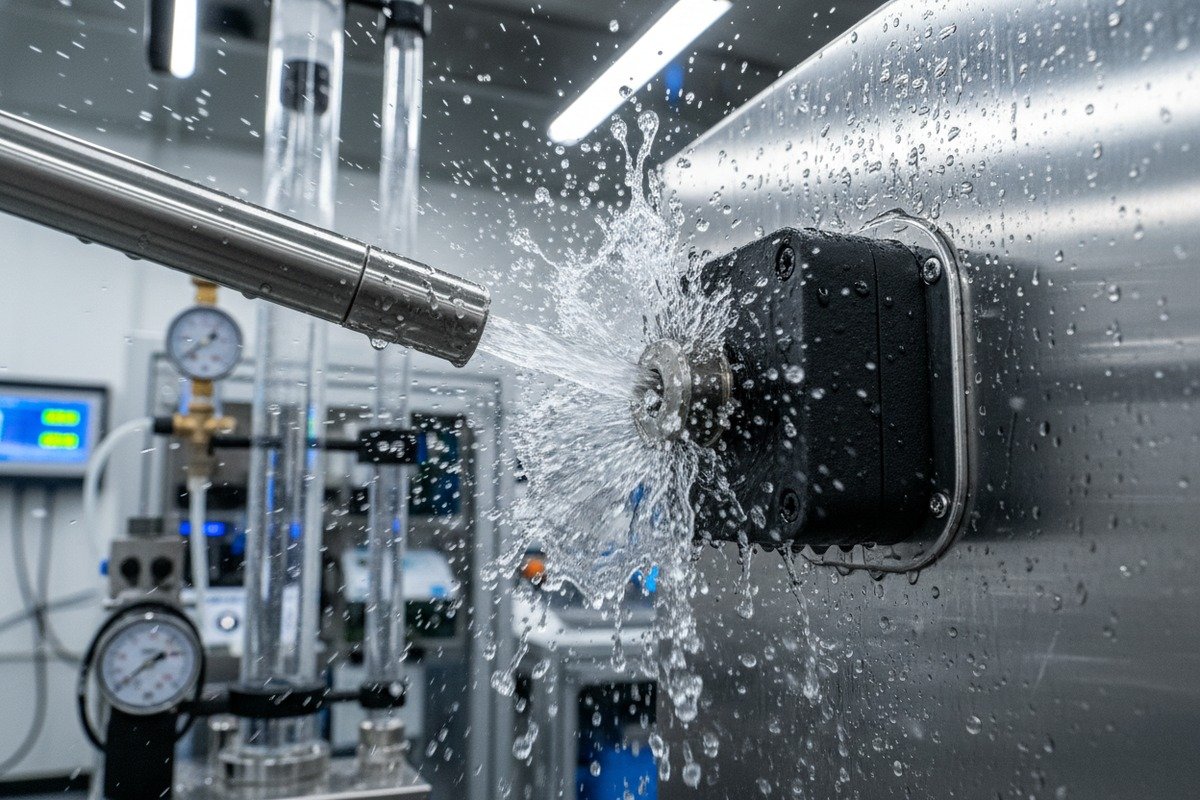
Understand the Difference Between IP66 and NEMA 4X
Many buyers use "IP66" and "NEMA 4X" interchangeably. They are related but not identical. IP66 is an IEC standard focused on dust and water jet protection. IEC 60529 6 NEMA 4X adds requirements for corrosion resistance and external icing. If your enclosure is outdoors in a coastal or chemical plant environment, you need NEMA 4X — not just IP66. NEMA 4X validation 7
| 표준 | Dust Protection | Water Protection | 내식성 | Ice/Sleet |
|---|---|---|---|---|
| IP65 | Complete (6) | Low-pressure jets (5) | 지정되지 않음 | 지정되지 않음 |
| IP66 | Complete (6) | Powerful jets (6) | 지정되지 않음 | 지정되지 않음 |
| NEMA 4 | Yes | Hosedown, rain, splashing | Not required | External icing |
| NEMA 4X | Yes | Hosedown, rain, splashing | Required (316SS or equivalent) | External icing |
Define Your Test Sequence
Testing should not happen only at the end. Our quality team runs checks at multiple stages:
- Material incoming inspection — Verify raw material certificates match the specification (e.g., 304 vs. 316 stainless steel).
- In-process dimensional checks — Confirm critical dimensions after die casting, CNC machining, and surface treatment.
- Engineering Validation Testing (EVT) — Test prototypes for mechanical cycle life, rotational torque, and cam engagement force.
- Environmental testing — IP66 water jet test, dust chamber test, and salt spray test (minimum 500 hours for outdoor applications, 1,000 hours for marine-grade).
- Final inspection — AQL sampling per ISO 2859 8 before packaging.
Mechanical Cycle and Torque Testing
A cam lock that passes environmental tests but fails mechanically after 6 months is useless. We test every new design to a minimum of 10,000 open-close cycles. During this test, we measure torque degradation, cam wear, and key interface looseness. For high-security applications, we push to 25,000 cycles.
Torque limits matter too. If the lock requires excessive force to operate, field technicians will complain. If it is too loose, it will not seal the gasket properly. Our engineering team sets a torque window — typically 0.3 to 0.8 Nm for standard quarter-turn cam locks — and validates it at EVT.
Insist on Traceable Test Reports
Every test report should include the batch number, date, test equipment calibration record, and pass/fail criteria. If your supplier cannot provide traceable documentation, that is a red flag. At our facility, we maintain full traceability from raw material lot numbers through to finished goods carton labels. This is not just good practice — it is a requirement for UL and TUV certification 9, both of which we hold.
We also run Automated Optical Inspection (AOI) at critical post-machining points. AOI systems catch surface defects, dimensional drift, and assembly errors that human inspectors might miss at production speed.
How do I optimize the SOP workflow to maintain consistent quality during mass production?
Scaling from 500 pieces to 50,000 pieces exposes every weakness in your workflow. We learned this the hard way years ago when a batch of 20,000 cam locks had inconsistent plating thickness because the SOP did not specify electroplating bath parameters tightly enough. That single gap cost us a full rework cycle.
Optimize your SOP workflow by documenting every production step with measurable parameters, establishing in-process quality checkpoints at die casting, machining, surface treatment, and assembly stages, training operators with standardized work instructions, and using statistical process control (SPC) to detect drift before defects occur.

Document Every Step With Measurable Parameters
A good SOP does not say "polish the surface until smooth." It says "polish to Ra 0.8 μm using 400-grit followed by 800-grit, inspect under 10x magnification, reject if visible scratches exceed 0.5 mm in length." Specificity eliminates interpretation. Interpretation creates variation. Variation creates defects.
Our SOPs cover the full production chain:
- Die casting — Injection temperature, pressure, cycle time, mold maintenance schedule
- Deburring — Tool type, RPM, pass count
- CNC machining — Toolpath, feed rate, coolant type, tool change intervals
- Surface treatment — Electroplating current density, bath chemistry, immersion time
- Assembly — Torque settings for fasteners, cam arm orientation, spring tension
- Packaging — Protective wrap, box configuration, labeling placement
Build Quality Gates Into the Process
Quality cannot be inspected into a product at the end. It has to be built in at every stage. We use a gate system where production cannot advance to the next step without passing the current checkpoint.
| Production Stage | Quality Gate | Inspection Method | Reject Criteria |
|---|---|---|---|
| Die casting | Dimensional check, porosity scan | CMM, X-ray (sampling) | Out-of-tolerance by >0.05 mm, visible porosity |
| CNC machining | Thread gauge, bore diameter | Go/no-go gauge, digital caliper | Thread failure, bore >±0.02 mm |
| 전기 도금 | Coating thickness, adhesion | X-ray fluorescence, cross-hatch tape test | Thickness <8 μm, adhesion failure |
| Assembly | Functional rotation, key engagement | Manual + torque wrench | Torque outside 0.3–0.8 Nm window |
| Final QC | Visual, dimensional, functional | AQL Level II sampling | Any critical defect = lot hold |
Use SPC to Catch Drift Early
Statistical Process Control is your early warning system. By charting critical dimensions and process parameters over time, you can spot trends before they become defects. For example, if the bore diameter on cam lock bodies starts trending upward over 200 pieces, your tooling is wearing. SPC flags this so you can change the tool before you produce out-of-spec parts.
Our quality engineers monitor SPC charts daily on key dimensions. When a parameter approaches a control limit, the production line pauses for investigation. This proactive approach has reduced our defect rate to below 0.3% on high-volume runs.
Train Operators With Visual Work Instructions
Written SOPs are important, but visual work instructions are better for the production floor. We use photo-based instruction cards at each workstation showing exactly how to position the part, what tools to use, and what a correct versus defective result looks like. New operators can reach competency faster, and experienced operators have a reference to prevent shortcuts.
Digital Workflow Management
We have implemented digital tracking through our production system. Every batch gets a unique ID. As it moves through each stage, operators scan a barcode to log completion. This gives our project managers — and our clients — real-time visibility into where their order stands. If a bottleneck forms at the plating station, we see it immediately and can reallocate resources.
What can I do to prevent logistics delays when moving from sample approval to bulk delivery?
The transition from "sample approved" to "bulk order shipped" is where many OEM projects hit an invisible wall. Our logistics coordinator once told me that 40% of delivery delays on custom cam lock orders originate not from production, but from the gap between approval and order confirmation — clients take weeks to sign off, then expect the original lead time to hold.
Prevent logistics delays by issuing a purchase order within five days of sample approval, pre-booking raw materials during the prototyping phase, aligning production scheduling with shipping windows, confirming Incoterms and customs documentation early, and maintaining a buffer stock of long-lead-time components like specialty key cylinders.

Close the Approval-to-PO Gap
The single biggest time killer is the delay between sample approval and purchase order issuance. Every week of delay pushes your delivery date back by at least that same week — often more, because production scheduling fills in behind you. We recommend clients set an internal deadline: approve or reject samples within five business days of receipt.
On our side, we prepare a production readiness checklist during the sampling phase. By the time the sample is approved, we already know the tooling status, material availability, and production line allocation. This parallel preparation shaves days off the lead time.
Pre-Position Raw Materials
For custom cam locks using standard materials — zinc alloy ZA-8, 304 stainless steel, brass C3604 — we maintain rolling inventory. But for specialty materials like 316L stainless steel or custom polymer compounds, lead times can stretch to three or four weeks. If we wait until PO confirmation to order these, the entire schedule slips.
Our approach: once a project reaches the prototype approval stage, we issue a preliminary material reservation with our suppliers. This is not a full purchase — it is a commitment to buy within a defined window. It reduces material lead time by 50% or more.
Align Production With Shipping Windows
Ocean freight from China to the US West Coast takes 14–20 days. East Coast adds another 7–10 days. If your production finishes on a Thursday and the next vessel booking is the following Wednesday, you lose almost a week. We plan production completion dates to align with vessel schedules, not the other way around.
For urgent orders, we offer air freight as an option, though the cost is significantly higher. A hybrid approach — air-shipping a first batch for immediate needs while the bulk order travels by sea — gives clients flexibility without breaking the budget.
Get Customs Documentation Right the First Time
Customs holds are preventable. The most common causes we see:
- Incorrect HS codes on the commercial invoice
- Missing or mismatched country-of-origin certificates
- Incomplete material declarations for corrosion-resistant coatings
- Lack of UL or TUV certification documents when required by the destination country
We prepare all export documentation in-house and review it against the destination country's import requirements before shipment. For US-bound orders, we confirm HS codes with our freight forwarder and ensure all TSCA and RoHS declarations are included.
Build a Communication Cadence
Delays also come from communication gaps. We assign a dedicated project coordinator to every OEM order. This person sends weekly status updates covering production progress, quality checkpoint results, and shipping timeline. If an issue arises — a material delay, a quality hold, a booking change — the client hears about it within 24 hours, not at the end of the month.
This transparency builds trust. And trust, in our experience exporting to North America and Europe over three decades, is what turns a one-time order into a long-term partnership.
결론
Managing OEM custom cam locks from 3D design to mass delivery is a chain — every link matters. Validate designs early, test rigorously against IP66 and NEMA standards, enforce SOPs at every production stage, and plan logistics before production ends.
Footnotes
1. The original URL was broken. This replacement provides a clear explanation of Design for Manufacturability (DFM) within the context of DFMA. ↩︎
2. The original URL returned a 404 error. This replacement offers a comprehensive guide to functional prototyping. ↩︎
3. Compares IP and NEMA ratings, explaining their different testing methods and parameters. ↩︎
4. The original URL returned a 403 error. This Wikipedia page provides an authoritative overview of Design for Assembly (DFA). ↩︎
5. The original URL returned a 403 error. This Wikipedia page offers an authoritative explanation of CNC machining. ↩︎
6. Official IEC page explaining the IEC 60529 standard for Ingress Protection (IP) ratings. ↩︎
7. Details NEMA 4X specifications, including protection against corrosion and external icing. ↩︎
8. Explains AQL sampling and its application in product inspections following ISO 2859 standards. ↩︎
9. Describes UL and TUV certifications, highlighting their role in product safety and compliance. ↩︎
10. Defines Statistical Process Control (SPC) as using statistical techniques to monitor and control processes. ↩︎







 Korean
  English
  Spanish
  French
  German
  Japanese
  Arabic
  Swedish
  Dutch
Dutch  Greek
Greek  Hindi
Hindi  Hebrew
  Italian
  Vietnamese
  Thai
Thai  Bulgarian
  Czech
Czech  Slovak
  Hungarian
  Finnish