
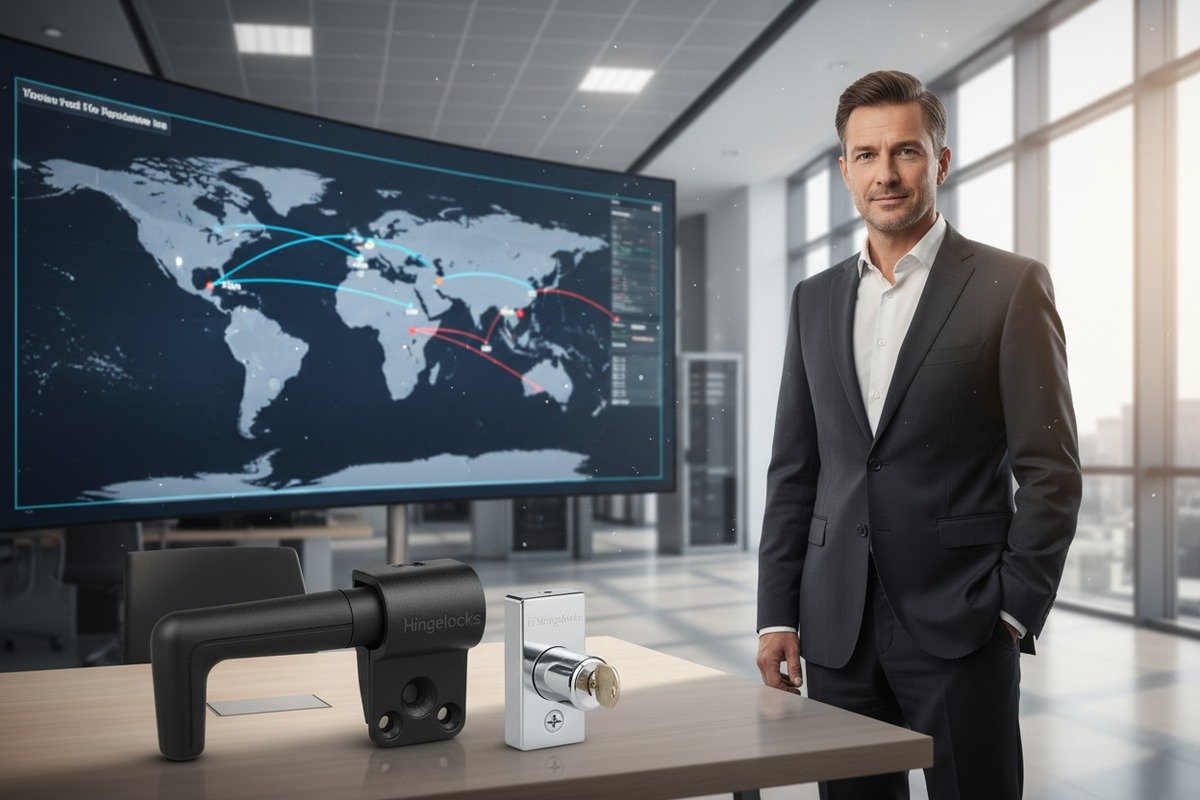
When our production team first encountered a two-week port delay that nearly shut down a client's assembly line, we realized that pure JIT thinking doesn't survive contact with trans-Pacific shipping realities.
To build a JIT safety stock model for urgent deliveries from Chinese suppliers, combine lean delivery scheduling with a calculated buffer stock for critical components, factor in lead time variability, shipping disruption risk, and supplier capacity, then use real-time tracking and expedited freight as contingency triggers.
This guide walks you through every step — from calculating ideal safety stock levels for cabinet hinges and latches, to coordinating urgent orders with your Chinese hardware supplier, to building an inventory model that actually works when things go wrong. Let's dig in.
How do I calculate the ideal safety stock for my cabinet hinges to avoid production downtime?
A single missing hinge can stop an entire enclosure assembly. We've seen it happen — and the cost of downtime always dwarfs the cost of a few extra boxes on a shelf.
Calculate safety stock using the formula: Safety Stock = Z × σ_demand × √Lead Time. For cabinet hinges from China, factor in 25–45 day ocean freight variability, demand fluctuation, and your desired service level (typically 95–99%) to find the minimum buffer that prevents production stops.

Understanding the Core Formula
The standard safety stock formula 1 is straightforward:
Safety Stock = Z × σ_d × √L
Kde:
- Z = Z-score 2 tied to your desired service level (1.65 for 95%, 2.33 for 99%)
- σ_d = Standard deviation of daily demand
- L = Average lead time in days
But this basic formula assumes stable lead times. When you source cabinet hinges or cam latches from China, lead times swing wildly. Port congestion, customs holds, and even Chinese New Year shutdowns 3 introduce variability that the simple formula ignores.
A better version for China-sourced components is:
Safety Stock = Z × √(L × σ_d² + d̄² × σ_L²)
Here, σ_L captures lead time variability 4a d̄ is your average daily demand. This dual-variability formula is critical for hardware importers.
Worked Example for Cabinet Hinges
Let's say you import our matte black cam latches for electrical enclosure assembly. Here are your numbers:
| Parameter | Value |
|---|---|
| Average daily demand (d̄) | 50 units |
| Standard deviation of demand (σ_d) | 10 units |
| Average lead time (L) | 35 days |
| Standard deviation of lead time (σ_L) | 7 days |
| Desired service level | 97.5% (Z = 1.96) |
Plugging in:
Safety Stock = 1.96 × √(35 × 100 + 2500 × 49)
Safety Stock = 1.96 × √(3,500 + 122,500)
Safety Stock = 1.96 × √126,000
Safety Stock = 1.96 × 355
Safety Stock ≈ 696 units
That's roughly 14 days of average demand as buffer. For a component that costs a few dollars each, this is cheap insurance against a production shutdown that could cost thousands per hour.
Service Level Selection Guide
Not every hinge or latch deserves the same buffer. Use a tiered approach:
| Component Criticality | Service Level | Z-Score | Typical Use Case |
|---|---|---|---|
| Line-stopping (single source) | 99% | 2.33 | Main cam latch for enclosure door |
| Important (substitutes exist) | 95% | 1.65 | Decorative trim hinges |
| Low-impact (easy to swap) | 90% | 1.28 | Internal cable management clips |
Our engineering team often advises clients to classify their hardware BOM this way. A polished chrome cam lock that's the only security point on a NEMA 4X enclosure? That's 99% service level territory. A standard hinge with three alternative suppliers? Drop to 95% and save on holding costs 5.
Don't Forget Holding Costs
Safety stock isn't free. Each unit sitting in your warehouse costs money — typically 20–30% of the item's value per year when you count warehousing, insurance, capital cost, and obsolescence risk. Run the math both ways: cost of holding extra stock versus cost of one day of downtime. For most industrial hardware buyers, the buffer wins easily.
How can I coordinate JIT delivery schedules with my Chinese hardware supplier for urgent orders?
Timing a delivery from Xi'an to Chicago within a narrow JIT window sounds impossible. But after shipping to over 30 countries for 35 years, we've learned the coordination playbook that makes it work.
Coordinate JIT deliveries with your Chinese supplier by establishing rolling forecasts shared monthly, pre-agreed expedited shipping triggers, bonded warehouse staging near your facility, and real-time order tracking — so urgent orders ship within 24 hours of confirmation rather than starting from scratch.
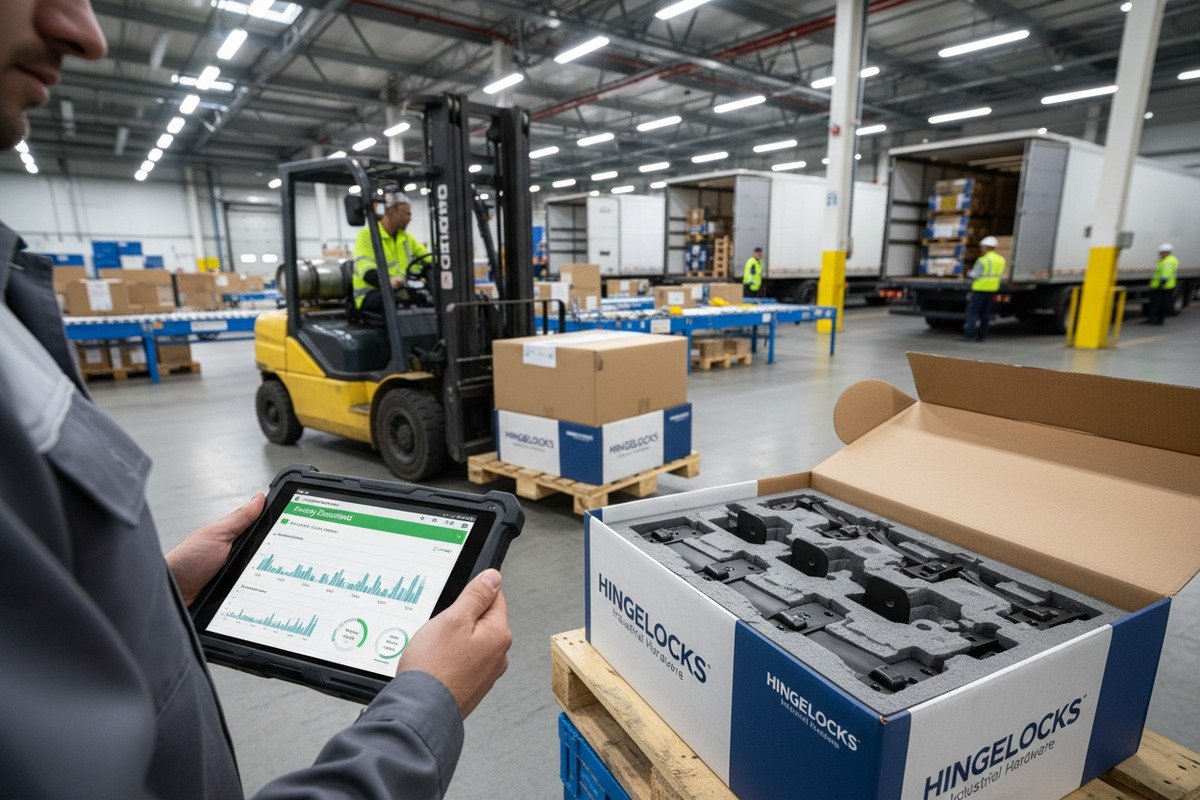
Build a Communication Rhythm
JIT coordination fails most often because of communication gaps, not shipping delays. Set up a structured rhythm:
- Monthly: Share a 90-day rolling demand forecast 6 with your supplier. Even rough numbers help us pre-stage raw materials (zinc alloy billets, stainless steel sheets) so production can start faster.
- Weekly: Exchange order status updates. A simple shared spreadsheet or ERP portal works. Our team targets responses within 14 hours — well under the 24-hour benchmark that top suppliers hit.
- Trigger-based: Define clear escalation triggers. If your inventory drops below reorder point, an automatic alert goes to both your purchasing team and the supplier's sales contact.
Define Urgency Tiers
Not every "urgent" order is equally urgent. Pre-agree on response protocols:
| Urgency Tier | Trigger Condition | Supplier Response | Shipping Method | Typical Timeline |
|---|---|---|---|---|
| Tier 1 — Critical | Stock below 3-day supply | Production priority + same-day dispatch confirmation | Air freight (express) | 5–7 days door-to-door |
| Tier 2 — High | Stock below 7-day supply | Next production batch priority | Air freight (standard) | 8–12 days |
| Tier 3 — Normal | Reorder point reached | Standard production queue | Ocean freight (FCL/LCL) | 30–45 days |
Having these tiers written into your supply agreement eliminates the back-and-forth negotiation that wastes days during a real crisis.
Use Staging Points Strategically
Pure direct-ship JIT from China is risky for urgent needs. Consider these staging strategies:
- Bonded warehouse in a Chinese Free Trade Zone (FTZ): We can hold finished goods — say, 500 polished chrome swing handle latches — in a bonded facility near Shanghai port. No duty is paid until goods ship. When you trigger a Tier 1 order, we dispatch from the FTZ instead of waiting for production.
- Regional hub in the US: If you consistently order multiple SKUs, keeping a small consignment at a 3PL warehouse near your plant gives you same-day access. We've helped several US enclosure manufacturers set this up with minimal cost.
- Vendor-Managed Inventory (VMI): In a VMI arrangement, we monitor your consumption data and proactively replenish. This shifts the coordination burden to us and keeps your shelves stocked without you placing individual POs.
Leverage Incoterms for Speed
Choosing the right Incoterm affects how fast goods move through the chain. For urgent JIT orders, DDP (Delivered Duty Paid) removes customs friction from your side entirely — we handle everything. Incoterm DDP 7 For routine shipments, FOB gives you more control over freight costs. Match the Incoterm to the urgency tier.
What factors should I include in my inventory model to handle shipping delays from China?
Last year, a Red Sea shipping disruption added 12 days to delivery times for one of our European clients overnight. Their model didn't account for route disruptions. Their production line stopped for three days.
Your inventory model should include ocean freight transit variability, port congestion buffers, customs clearance time, seasonal factory shutdowns (Chinese New Year), geopolitical tariff risk, carrier reliability scores, and a disruption multiplier that adjusts safety stock dynamically when risk indicators spike.
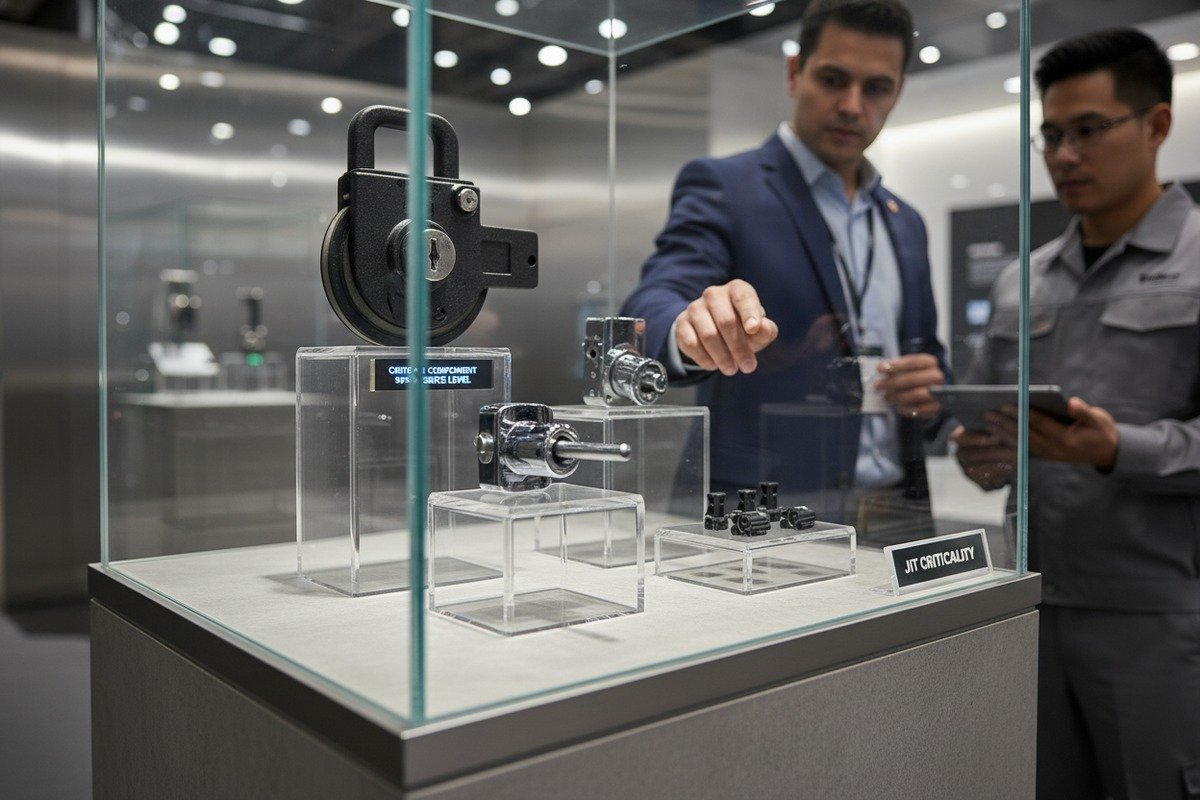
Map Every Delay Source
Most inventory models only look at "lead time" as one number. For China-sourced cabinet hardware, break it into discrete segments — each with its own variability:
- Order processing: 1–2 days. Low variability.
- Production: 15–35 days. Moderate variability depending on customization, batch size, and factory load.
- Inland transport to port: 1–5 days. Varies by factory location. Our Xi'an facility uses rail to Shanghai or truck to Shenzhen.
- Port waiting and loading: 1–7 days. High variability during peak season (August–October).
- Ocean transit: 18–35 days depending on US West Coast vs. East Coast. Route disruptions (Suez, Red Sea, Panama Canal drought) can add 7–15 days.
- US port unloading and customs: 2–10 days. Tariff code disputes or random inspections cause spikes.
- Last-mile domestic transport: 1–5 days.
Total window: 39–99 days. That range alone tells you why a single "average lead time" number is dangerous.
Build a Disruption Multiplier
A static model breaks during crises. Add a disruption multiplier (DM) that scales your safety stock when risk indicators change:
| Risk Condition | Disruption Multiplier | Action |
|---|---|---|
| Normal operations | 1.0x | Standard safety stock |
| Minor port congestion reported | 1.3x | Increase buffer by 30% |
| Major route disruption (e.g., Red Sea) | 1.7x | Increase buffer by 70%, trigger Tier 2 air freight |
| Geopolitical escalation (tariff announcement) | 2.0x | Double buffer, evaluate pre-shipment of 60-day supply |
| Chinese New Year (Jan–Feb) | 1.5x | Place orders 45 days earlier than normal |
Monitor these triggers using free tools: Freightos Baltic Index for shipping rates (a spike signals congestion), US Customs and Border Protection alerts, and your supplier's own capacity updates.
Seasonal Adjustment Is Non-Negotiable
Every year, Chinese factories slow down or close for 15–25 days around Chinese New Year. If your model doesn't account for this, you'll face a gap every February. We always advise clients to place their Q1 orders by mid-November and add 1.5x safety stock heading into the holiday period.
Include the Urgency Cost Premium
Your model should quantify what a delay actually costs you. Calculate:
- Expedited shipping premium: Air freight from China costs 5–8x more than ocean freight per kg.
- Production downtime cost: Labor idle time, missed delivery penalties to your end customer.
- Customer churn risk: One late delivery might not lose a client. Three in a row will.
When you assign dollar values to these outcomes, the "cost" of holding extra safety stock looks very reasonable. One client told us that a single day of assembly line downtime costs $8,000. Holding an extra 1,000 cam latches at $2.50 each costs $2,500 in inventory — less than a third of one lost day.
Use Digital Twins for Stress Testing
If your operation is large enough, run Monte Carlo simulations on your inventory model. Input variable distributions for each lead time segment, randomize demand, and see how often you stock out under different safety stock levels. Even a basic Excel model with random number generation can reveal whether your buffer is adequate. Several of our OEM partners have started using this approach after post-COVID disruptions exposed gaps in their deterministic models.
How can I use my supplier's manufacturing capacity to lower my own safety stock costs?
Here's something most procurement managers overlook: your supplier's factory is itself a form of inventory. When we keep raw materials pre-staged and production slots reserved, your need for finished goods buffer drops significantly.
Leverage your supplier's manufacturing capacity by negotiating reserved production slots, pre-positioned raw material agreements, consignment inventory programs, and flexible batch sizing — effectively shifting part of the safety stock burden upstream to the factory floor, where holding costs are lower and response times are faster.
Reserved Production Slots
At our facility, we run multiple product lines simultaneously — industrial cam latches, swing handle locks, concealed hinges, and custom OEM pieces. Production scheduling is a constant puzzle. But for key long-term clients, we reserve weekly production slots. This means when an urgent order comes in, it doesn't enter a 15-day queue. It enters a pre-booked window and ships within 3–5 days.
The cost to you? Usually a small volume commitment — a minimum quarterly order that you'd likely meet anyway. The benefit? Your effective lead time drops from 35 days to under 10, which slashes the safety stock you need by more than half.
Pre-Positioned Raw Materials
Another approach: fund or commit to raw material pre-positioning. If you know you'll need 10,000 zinc alloy cam locks over the next quarter, we can purchase the zinc alloy billets and stainless steel sheets in advance. When your order arrives, we skip the 7–10 day material procurement phase and go straight to production.
This is especially valuable for custom or OEM items where the specific alloy, finish (matte black, polished chrome), or tooling is unique to your product. Standard catalog items can draw from general stock, but custom pieces need this kind of planning.
Consignment and VMI Programs
In a consignment model, we produce goods and hold them at our warehouse (or a third-party facility) until you call them off. You only pay when goods ship. This arrangement works well for high-volume, repeat items like standard cabinet hinges or panel locks.
In a VMI (Vendor-Managed Inventory) setup, we go further — monitoring your consumption data and proactively producing replenishment batches. Your purchasing team spends less time on POs, and our production planning becomes smoother because we see demand signals earlier.
Quantifying the Savings
Let's compare three scenarios for a client using 2,000 polished chrome cam locks per month:
| Strategy | Safety Stock Needed | Holding Cost (Annual) | Effective Lead Time | Stockout Risk |
|---|---|---|---|---|
| Standard ordering (no coordination) | 4,000 units | $12,000 | 35 days | Moderate |
| Reserved production slots | 1,500 units | $4,500 | 8 days | Nízká |
| VMI with consignment at 3PL hub | 800 units | $2,400 | 2 days | Very low |
The VMI approach cuts holding costs by 80% and virtually eliminates stockout risk. The trade-off is deeper collaboration and data sharing with your supplier — but for critical components, that investment pays for itself many times over.
Supplier Qualification Matters
Not every supplier can offer these programs. When evaluating a Chinese hardware supplier for JIT capacity leverage, check:
- On-time delivery rate: 95%+ is the benchmark. Ask for data, not promises.
- Certifications: ISO 9001 8 is table stakes. UL, TUV, and IAPMO certifications signal process discipline. Our facility holds all three.
- Response time: Can they confirm an urgent order within 24 hours? Our target is under 14 hours.
- Testing infrastructure: We operate 35+ testing devices in-house. A supplier without robust QC will send you defective parts that cause more downtime than a late shipment.
- Capacity headroom: If a factory is running at 98% utilization, there's no room for your urgent orders. Look for suppliers with planned overcapacity or flexible shift arrangements.
The bottom line: your supplier's factory is not just a vendor. It's an extension of your inventory system. Treat it that way, and your safety stock costs — and your stress levels — drop dramatically.
Závěr
Building a JIT safety stock model 10 for Chinese supplier deliveries isn't about choosing lean or buffer — it's about combining both intelligently, using data, supplier collaboration, and contingency tiers to keep your production line running no matter what happens at sea.
Footnotes
1. Provides a foundational calculation for inventory management. ↩︎
2. Defines a key statistical component in safety stock calculation. ↩︎
3. Addresses a significant seasonal disruption in Chinese manufacturing. ↩︎
4. Highlights a critical challenge in international sourcing and its impact. ↩︎
5. Replaced HTTP 404 with a comprehensive guide on inventory holding costs, including definition, calculation, and reduction strategies. ↩︎
6. Describes a crucial communication tool for JIT coordination. ↩︎
7. Clarifies a specific international trade term relevant to urgent shipments. ↩︎
8. Refers to a widely recognized quality management standard in supply chains. ↩︎
9. Describes an advanced inventory management strategy for supplier collaboration. ↩︎
10. Explains how JIT and safety stock are combined for urgent deliveries. ↩︎





 Czech
Czech  English
  Spanish
  French
  German
  Japanese
  Arabic
  Korean
  Swedish
  Dutch
Dutch  Greek
Greek  Hindi
Hindi  Hebrew
  Italian
  Vietnamese
  Thai
Thai  Bulgarian
  Slovak
  Hungarian
  Finnish