

Every year, our engineering team reviews field returns, and one pattern keeps showing up: locking system failures traced back to poor stress analysis during the design phase.
Analyzing mechanical stress for quarter-turn and multi-point locking systems requires evaluating preload, axial loads, torsional forces, and vibration resistance through methods like Finite Element Analysis (FEA), cycle-life testing, and material selection. Quarter-turn locks suit quick-access, point-load applications, while multi-point systems distribute stress evenly across larger panels.
This guide walks you through the core stress types, analysis tools, selection criteria, and real-world testing methods cycle-life testing 1. Whether you build electrical enclosures or telecom racks, you will find practical steps below.
How do I choose between quarter-turn and multi-point locking systems for my high-stress industrial cabinets?
We have shipped over 200 custom locking configurations to North American cabinet manufacturers in the past three years, and the most common question always comes down to this: single-point or multi-point material selection 2?
Choose quarter-turn locks when you need fast, tool-less access and the panel is small with concentrated loads. Choose multi-point locking systems when the door is large, faces uneven pressure, or must meet strict sealing and security standards across its full surface.
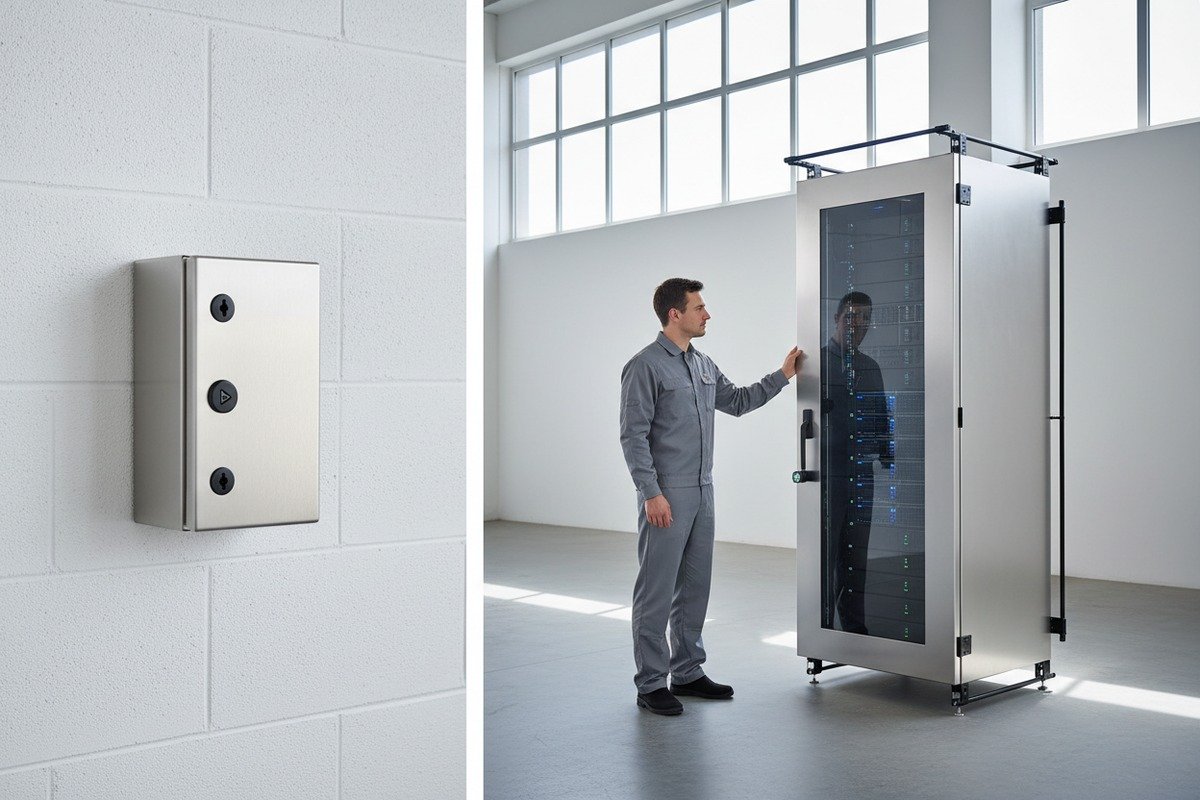
Understanding the Core Mechanisms
A quarter-turn lock 3 works with a simple 90-degree rotation. A stud with a cross-pin rides up a cam groove. A spring element creates preload. This preload holds the panel tight against vibration. The design dates back to the 1930s, originally built for aircraft panels that shook violently during flight.
A multi-point system 4, on the other hand, locks at two, three, or more points along the door edge. It uses cams or latches connected by rods. One handle or actuator drives them all at once. Some multi-point systems even use quarter-turn actuators at each locking point for simultaneous engagement.
Key Differences at a Glance
| Feature | Quarter-Turn Lock | Multi-Point Lock |
|---|---|---|
| Locking Points | 1 (single point) | 2–5 or more |
| Rotation to Lock | 90 degrees | Single handle drives multiple cams |
| Best Panel Size | Small to medium (up to ~600 mm) | Large (600 mm and above) |
| Stress Distribution | Concentrated at one point | Distributed evenly across panel |
| Installation Complexity | Nízká | Moderate to high |
| Typical Use | Electrical cabinets, HVAC panels | Server racks, large industrial doors |
| Sealing Performance | Good (with gasket compression) | Excellent (uniform compression) |
When Quarter-Turn Is the Better Fit
If your cabinet door is relatively small and your team needs to open it frequently for maintenance, a quarter-turn lock saves time. The 90-degree operation means faster service. Cycle life is also higher because the low torque minimizes recess wear over time.
In our production facility, we test quarter-turn locks to over 10,000 cycles without measurable degradation when paired with proper stainless steel studs. For vibration-heavy environments like transportation or machinery housings, adding a safety variant with an internal pin ensures the lock cannot shake open.
When Multi-Point Wins
Large doors warp. That is a fact. A single locking point cannot keep a 1200 mm tall door flush against the frame. Gaps appear. Seals fail. Dust and water get in. Multi-point systems solve this by pulling the door tight at multiple positions.
Our engineers often recommend a three-point system for any panel taller than 800 mm, especially when IP66 sealing 5 is required. The even compression along the gasket line prevents the hot spots that cause seal degradation over time.
The Trade-Off: Simplicity vs. Coverage
Quarter-turn locks are cheaper and easier to install. One cutout, one retainer, done. Multi-point systems cost more and require precise rod alignment. But in high-stress cabinets exposed to vibration, thermal cycling, or external pressure, multi-point systems pay for themselves by reducing warranty claims and field failures.
What methods should I use to test the mechanical durability of my multi-point latches in harsh environments?
When we onboard a new OEM client, the first thing our test lab does is ask about the real-world conditions: temperature swings, salt spray, vibration profiles, and how often the door gets opened.
Test multi-point latch durability using accelerated cycle-life testing, vibration simulation (per IEC or MIL standards), salt spray corrosion testing, FEA stress modeling, and environmental chamber trials. Combine these methods to predict fatigue, identify weak points, and validate performance before field deployment.
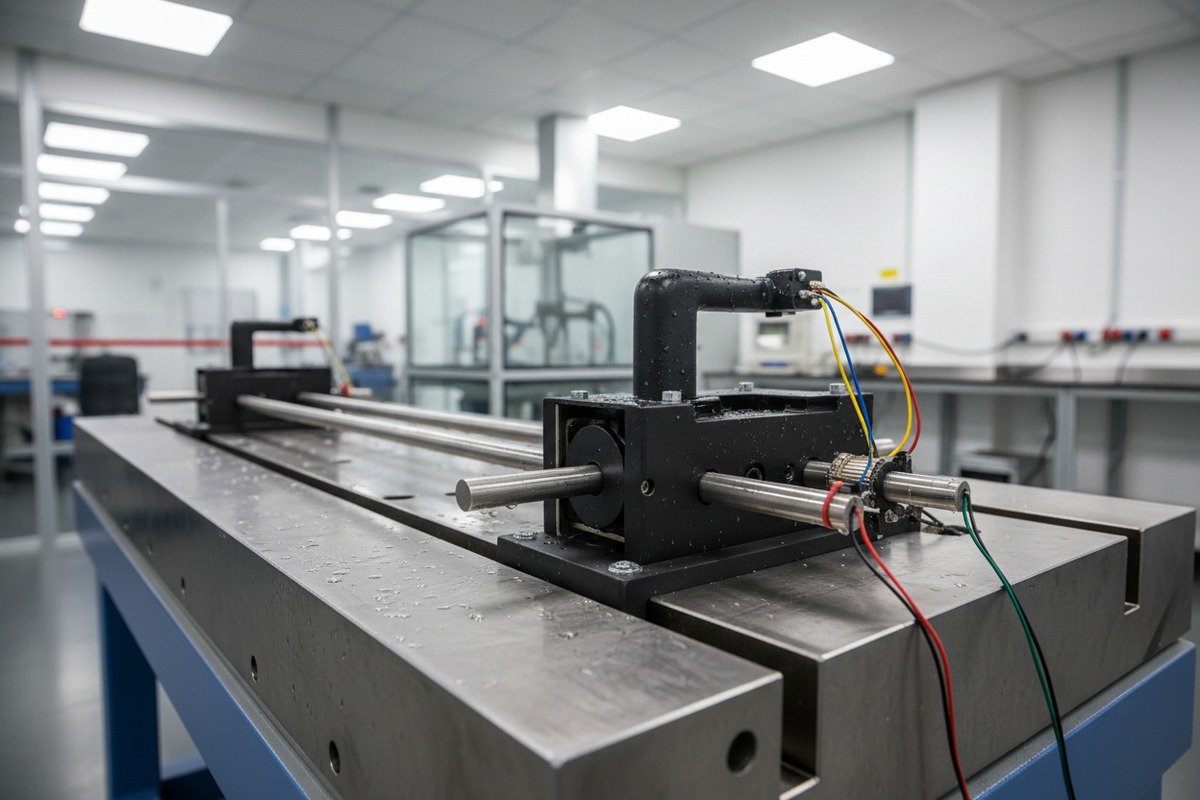
Finite Element Analysis (FEA): Start Digital
Before any physical test, run FEA simulations on the critical components: cams, connecting rods, the handle mechanism, and the housing. FEA lets you simulate cam-pin interactions, preload distribution, and deformation under combined axial and torsional loads. Finite Element Analysis (FEA) 6
Our R&D team uses FEA to identify stress concentrations around cam pivot points. A typical simulation applies service loads along two perpendicular axes simultaneously. If the von Mises stress exceeds 70% of the material's yield strength, we redesign before cutting steel.
Physical Testing Protocols
| Test Type | Standard/Method | What It Measures | Typical Pass Criteria |
|---|---|---|---|
| Cycle Life | 10,000–50,000 open/close cycles | Wear, fatigue, mechanism integrity | No functional failure or >10% force increase |
| Vibration | IEC 60068-2-6 7 or MIL-STD-810 | Resistance to loosening and fatigue | No unlatching, no crack propagation |
| Salt Spray | ASTM B117 8 (500–1000 hours) | Corrosion resistance | No red rust on functional surfaces |
| Thermal Cycling | -40°C to +85°C, 100 cycles | Material expansion, seal integrity | No cracking, seal remains intact |
| Impact/Shock | IEC 60068-2-27 | Resistance to sudden force | Latch remains engaged after impact |
| IP Ingress | IEC 60529 (IP66/IP67) | Dust and water sealing under pressure | Zero dust ingress, no water penetration |
Vibration Testing in Detail
Vibration is the silent killer of locking systems. A latch that feels rock-solid on the bench can rattle loose after 48 hours on a moving train. We mount the complete assembly—door, frame, gasket, and multi-point lock—on a vibration table. Then we sweep through frequencies from 5 Hz to 500 Hz at defined amplitudes.
The key metric is whether the latch remains fully engaged and the preload drops below the minimum gasket compression threshold. If it does, the detent groove design or spring rate needs adjustment.
Corrosion and Environmental Stress
For outdoor cabinets—telecom base stations, EV chargers, wind turbine control panels—salt spray testing is non-negotiable. We run 304 stainless steel components through 1,000 hours of salt fog as a baseline. Zinc alloy parts get powder coating plus 500-hour exposure. Any component showing functional corrosion gets rejected.
Thermal cycling is equally important. Repeated expansion and contraction can loosen press-fit pins and degrade polymer seals. We test at extremes: -40°C to +85°C, holding at each temperature for 30 minutes per cycle, running 100 full cycles minimum.
Combining Digital and Physical Results
The most reliable durability assessment cross-references FEA predictions with physical test data. If FEA predicts a fatigue hotspot at the cam root after 20,000 cycles, and your physical test shows a micro-crack at 18,000 cycles, you have strong validation. This correlation builds confidence in future designs without needing to prototype every variation.
How can I ensure my quarter-turn locking system meets IP66 standards under significant physical pressure?
One of our US distributors once returned a batch of quarter-turn locks that passed bench-level IP66 testing but failed in the field. The root cause was simple: the cabinets sat on a loading dock where forklifts drove past and panels flexed under air pressure differentials.
To ensure IP66 compliance under physical pressure, use quarter-turn locks with sufficient preload to maintain gasket compression, select elastomer seals rated for your temperature range, verify sealing with pressurized water jet tests per IEC 60529, and account for panel deflection that reduces effective compression force.

What IP66 Actually Demands
IP66 means complete protection against dust ingress (level 6) and resistance to powerful water jets from any direction (level 6). The test involves a 12.5 mm nozzle delivering 100 liters per minute at 3 meters distance for at least 3 minutes. That is serious pressure against a cabinet door.
The lock itself does not achieve IP66 alone. The entire system—lock, gasket, panel, and frame—must work together. A quarter-turn lock's job in this system is to generate enough compressive force to keep the gasket sealed.
Preload and Gasket Compression
The spring inside a quarter-turn lock creates preload when the stud rotates into the locked position. This preload must exceed the minimum compression force the gasket material requires to seal. If the preload is too low, water pushes through. If it is too high, the gasket deforms permanently and loses elasticity over time.
Our engineering team calculates preload using a straightforward relationship:
F_preload = k_spring × δ_cam
Where k_spring is the spring constant and δ_cam is the cam lift distance during the 90-degree rotation. We target a preload that compresses the gasket to 20–30% of its free height. This range works for most EPDM and silicone seals 9.
Panel Deflection: The Hidden Enemy
Here is what many engineers miss. Under wind load, thermal expansion, or nearby machinery vibration, the panel between locking points deflects outward. This deflection reduces effective gasket compression at the panel center, even if the lock itself maintains full preload at its mounting point.
For panels wider than 400 mm with a single quarter-turn lock, we recommend either adding a second lock or switching to a compression latch that provides higher thrust. Our compression cam latches deliver up to 800 N of closing force—double what a standard quarter-turn spring provides.
Material Selection for Sealing Integrity
| Component | Recommended Material | Why It Matters for IP66 |
|---|---|---|
| Stud/Cam | 304 or 316 Stainless Steel | Resists corrosion that causes surface pitting, which breaks seal contact |
| Bydlení | Zinc Alloy (powder coated) | Maintains dimensional stability; coating prevents galvanic corrosion |
| Gasket | EPDM (standard) or Silicone (high temp) | EPDM handles -40°C to +120°C; silicone extends to +200°C |
| Spring | Stainless Steel wire | Prevents rust-induced loss of spring force over time |
| Retainer Clip | 301 Stainless Steel | Maintains clamping force through repeated cycles |
Testing Beyond the Standard
At our facility, we go beyond the minimum IEC 60529 requirements. We test IP66 sealing after 5,000 operational cycles to check whether repeated opening and closing degrades the seal. We also test after thermal cycling—because a gasket that seals at 25°C may not seal at -30°C when the rubber hardens.
For clients in the energy storage and EV charging sectors, we add a pressurized box test: we seal the enclosure, pressurize the interior to 50 Pa above ambient, and measure leakage rate. This catches micro-gaps that a water jet test might miss.
Where can I find a manufacturer to customize locking systems that handle my specific mechanical load requirements?
Last year, a telecom rack manufacturer in Germany asked us to develop a quarter-turn lock that could withstand 1,200 N axial pull-out force while fitting inside a 22 mm panel cutout. No catalog product could do it. That is when custom engineering becomes essential.
Find a qualified manufacturer by evaluating their R&D capability, testing infrastructure, material certifications (UL, TUV, IAPMO), willingness to do small-batch OEM/ODM runs, and ability to provide FEA analysis and free CAD design support for your specific load and environmental requirements.

What to Look for in a Custom Locking System Supplier
Not every lock factory can handle custom mechanical load specifications. Many produce standard catalog items and lack the engineering depth to modify cam profiles, spring rates, or material grades for unusual applications. Here is what separates a capable partner from a basic supplier.
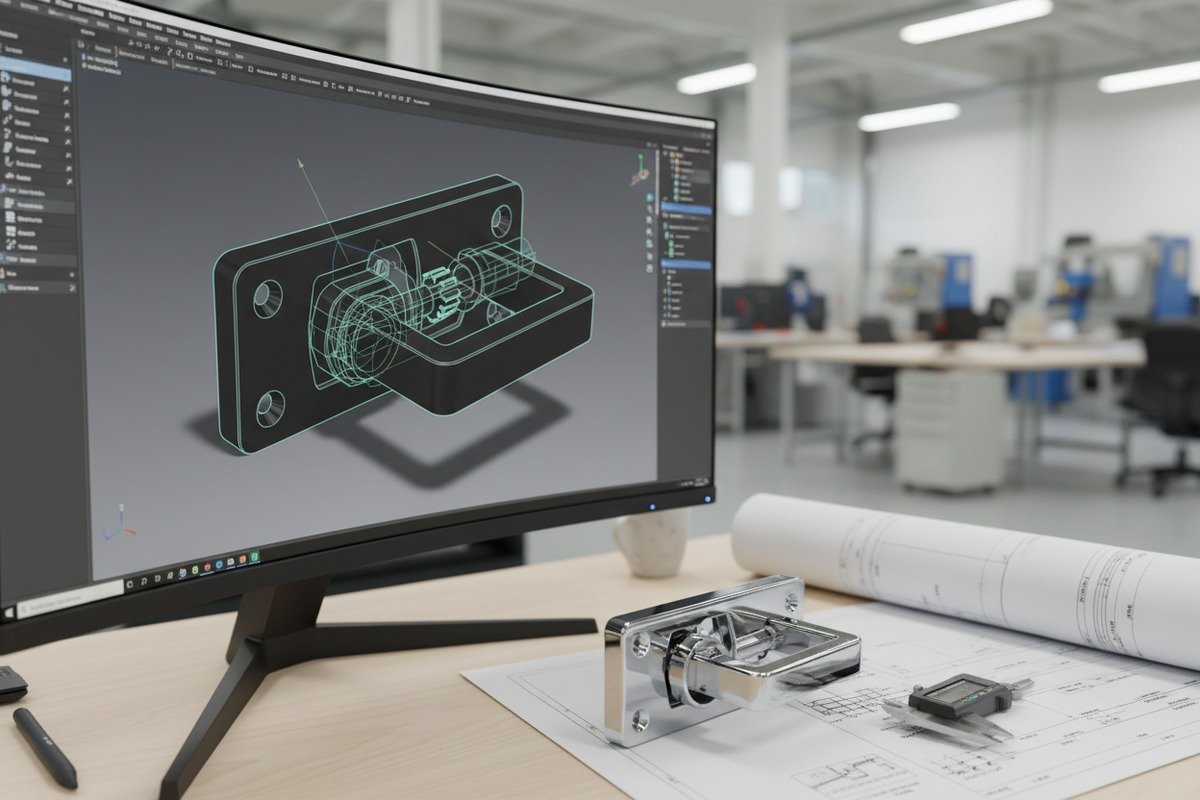
First, ask about their R&D team. Do they have mechanical engineers who understand stress analysis? Can they run FEA in-house? At our Xi'an facility, we have a dedicated engineering group that works with clients to translate load requirements into physical designs. We provide free CAD models before any tooling commitment.
Second, check their testing equipment. With over 35 testing devices in our lab—including vibration tables, salt spray chambers, cycle-life rigs, and IP ingress stations—we validate every custom design before shipping samples. A manufacturer without testing infrastructure is guessing, not engineering.
Certifications Matter
For North American and European markets, your locking components must carry recognized certifications. UL listing 10 ensures electrical enclosure safety compliance. TUV certification validates mechanical performance under EU standards. IAPMO certification covers plumbing and mechanical codes relevant to certain cabinet installations.
We hold all three. This matters because certification is not just a sticker. It means the manufacturer's quality management system, material traceability, and production consistency have been independently audited.
The Customization Process
A good custom engagement follows a clear path:
- Requirement gathering — You share load specs, panel dimensions, environment conditions, and sealing needs.
- Concept design — The manufacturer provides CAD models and preliminary FEA results.
- Prototype — Small-batch samples (we support runs as low as 100 pieces) for your validation.
- Testing — Joint review of cycle-life, vibration, corrosion, and IP test data.
- Production — Full-scale manufacturing with agreed quality controls and delivery timelines.
Our typical lead time is 15–35 days from design approval to shipment, depending on material sourcing and finish requirements.
Evaluating Manufacturer Capability: A Quick Checklist
Ask these questions before committing:
- Can they modify spring rates and cam profiles for your specific preload requirements?
- Do they stock multiple material grades (304 SS, 316 SS, zinc alloy, reinforced nylon)?
- Will they provide FEA reports showing stress distribution under your stated loads?
- Can they produce small initial batches without demanding high MOQs?
- Do they offer free samples and CAD design services?
- What is their defect rate, and how do they handle field failures?
If you are sourcing from China, platforms like Alibaba can surface candidates, but always request factory audit reports and speak directly with the engineering team. Trade shows like Hannover Messe or CEATEC also connect buyers with qualified hardware manufacturers.
For projects involving distribution cabinets, server racks, energy storage enclosures, or EV charging stations, feel free to reach out to our team at sales@hingelocks.com. We have worked with procurement managers across the US and Europe who needed exactly this kind of tailored support, and we understand the stakes when a locking system fails in the field.
Závěr
Choosing and validating locking systems starts with understanding mechanical stress. Use FEA, rigorous testing, and the right manufacturing partner to get it right the first time.
Footnotes
- Describes the process of simulating long-term use to predict product performance. ↩︎
- TWI provides a comprehensive and authoritative guide on material selection, covering its definition, process, and examples relevant to engineering design. ↩︎
- Explains the basic operation and common applications of quarter-turn locks. ↩︎
- Describes a locking mechanism that secures a door at multiple points for enhanced security. ↩︎
- The International Electrotechnical Commission (IEC) is the authoritative source for IP ratings, and this page explains the IP code system, including IP66. ↩︎
- Wikipedia provides a comprehensive and authoritative overview of the Finite Element Method (FEM) and its application, Finite Element Analysis (FEA). ↩︎
- Specifies the international standard for sinusoidal vibration testing of equipment. ↩︎
- Defines the standard practice for operating salt spray (fog) apparatus for corrosion testing. ↩︎
- Compares properties and applications of EPDM and silicone rubber for sealing. ↩︎
- Explains UL certification for product safety and market acceptance. ↩︎







 Czech
Czech  English
  Spanish
  French
  German
  Japanese
  Arabic
  Korean
  Swedish
  Dutch
Dutch  Greek
Greek  Hindi
Hindi  Hebrew
  Italian
  Vietnamese
  Thai
Thai  Bulgarian
  Slovak
  Hungarian
  Finnish