

Every year, we see trial orders rejected at European ports because locks failed basic compliance checks nobody bothered to run before shipping.
To implement PSI for European standard electrical cabinet lock trial orders, define clear inspection checkpoints covering CE marking, IP ratings, corrosion resistance, dimensional accuracy, and functional testing. Use independent third-party inspectors, apply risk-based sampling plans, and verify all documentation before shipment leaves the factory.
This guide walks you through exactly how to set up a pre-shipment inspection process for small-batch cabinet lock orders destined for Europe. We will cover compliance standards, quality checkpoints, why PSI matters for first orders, and how to verify durability before your locks cross the border.
How do I ensure my trial order of cabinet locks complies with European safety and IP standards during a PSI?
When we ship cabinet locks to Germany or France, the first question every buyer asks is about CE compliance and IP rating proof — and rightfully so.
During PSI, verify CE marking documentation, test IP ratings per IEC 60529, confirm IEC 61439 and EN 60204-1 compliance, and check material certificates. Use calibrated tools to measure ingress protection and ensure each lock meets the declared safety class before sealing any shipment.
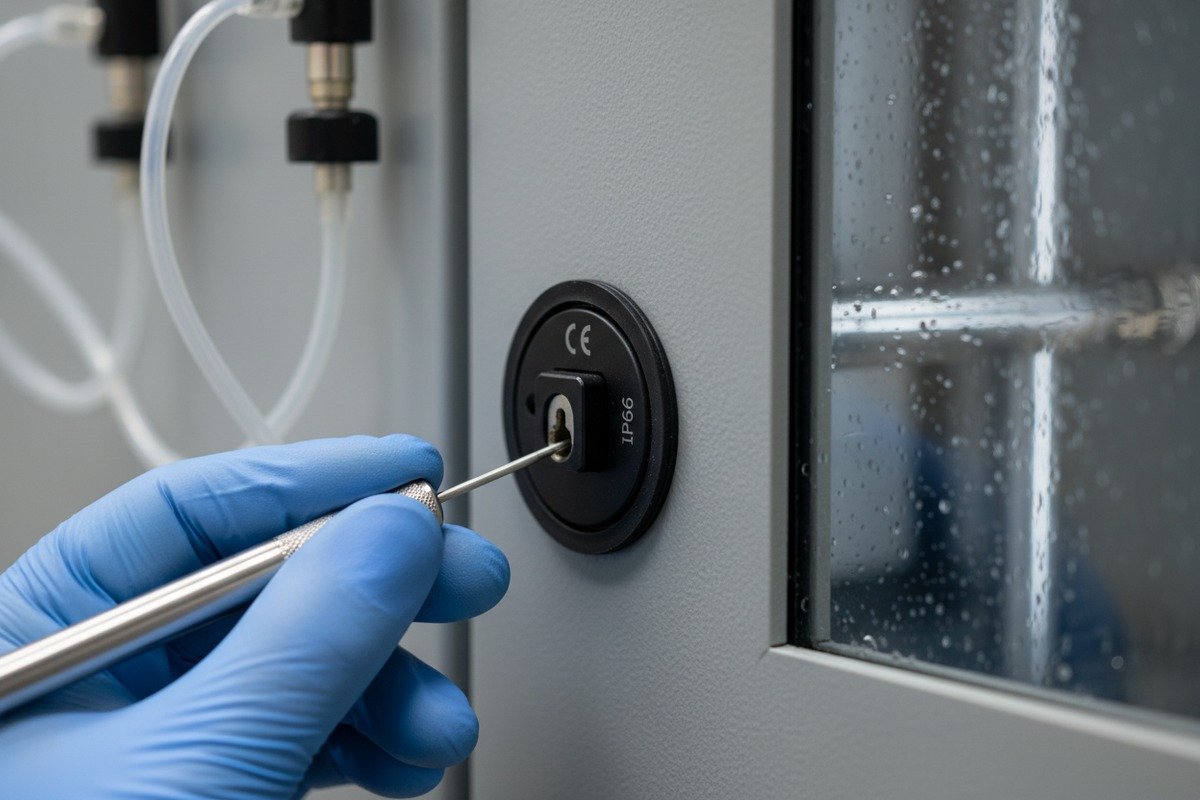
Understanding the Core European Standards
European electrical cabinet locks must comply with several overlapping standards. The most critical ones are IEC 61439 1 for low-voltage switchgear assemblies, EN/IEC 60204-1:2016 for electrical equipment of machines, and BS EN 12209 2 for building hardware locks. Each standard addresses different aspects of the lock's role in the cabinet system.
Pour IP ratings 3, IEC 60529 defines the ingress protection levels. Most European buyers require at least IP54 for indoor industrial cabinets and IP66 or higher for outdoor enclosures. During PSI, inspectors must confirm that the lock assembly — not just the lock body — achieves the rated IP level when installed.
Our testing lab runs IP verification on every new mold design. We use a calibrated spray nozzle rig and a dust chamber with talcum powder to simulate real ingress conditions. If a lock passes in isolation but fails when mounted on a sample panel, we redesign the gasket interface before any trial shipment goes out.
Key Compliance Checks During PSI
| Checkpoint | Standard | What to Verify | Pass Criteria |
|---|---|---|---|
| CE Marking 4 | EU Machinery Directive 2006/42/EC | Declaration of Conformity, technical file | Valid DoC with Notified Body reference |
| IP Rating | IEC 60529 5 | Dust and water ingress testing | Meets declared IP class (e.g., IP66) |
| Material Safety | REACH / RoHS | Restricted substance test reports | Below SVHC thresholds |
| Electrical Safety | EN/IEC 60204-1:2016 6 | Insulation resistance, earth bonding | ≥1MΩ at 500V DC; earth ≤0.1Ω |
| Mechanical Strength | BS EN 12209 | Lock torque, cycle endurance | ≥10,000 cycles without failure |
Documentation You Must Collect
Before the inspector arrives, gather the full technical file. This includes material certificates for zinc alloy or stainless steel bodies, plating thickness reports for chrome finishes, and third-party test reports from accredited labs. Our team at Hingelocks prepares a compliance dossier for every trial order that includes CAD drawings, tolerance sheets, and salt spray test data.
One common mistake is assuming a supplier's internal test report is enough. European importers and market surveillance authorities may request accredited lab reports. If your PSI does not flag missing documentation, you risk delays at customs or worse — a product recall.
The Role of Third-Party Inspectors
Always use an independent third-party inspection agency for trial orders. They bring calibrated instruments, standardized checklists, and zero bias. In our experience, buyers who skip third-party PSI on trial orders end up spending three times more on rework and re-shipping than the inspection would have cost.
What specific quality checkpoints should I include in my PSI for electrical cabinet hinges and latches?
Our production floor handles over 200 different hinge and latch SKUs, and we have learned that a generic checklist misses the details that matter most for cabinet hardware.
Your PSI should include visual inspection for surface defects, dimensional verification against CAD drawings, functional testing of locking and hinging mechanisms, torque measurements, cycle endurance spot checks, plating thickness measurement, and packaging integrity assessment — all documented with photographs and data sheets.
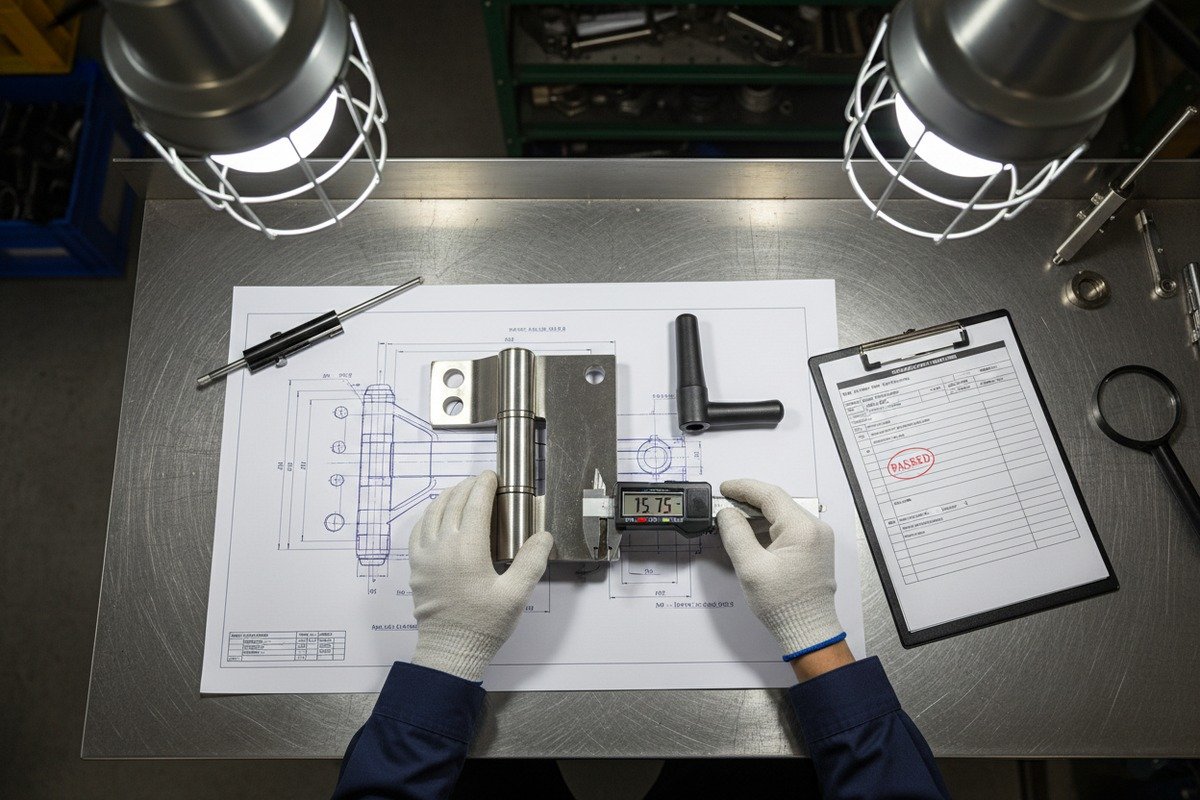
Visual and Dimensional Inspection
Start with a 100% visual scan on trial orders. Look for casting voids, burrs, uneven plating, scratches, and misaligned components. For small batches of 50–500 pieces, a 100% visual check is practical and strongly recommended. Dimensional checks should use calipers and go/no-go gauges against the approved drawing.
Our quality team uses a coordinate measuring machine (CMM) for critical dimensions on custom orders. For standard latches, we check three key dimensions: mounting hole spacing, cam arm length, and overall body thickness. Even a 0.3mm deviation on mounting holes can cause installation failures on European-standard 19-inch racks.
Functional and Mechanical Testing
Every latch must open and close smoothly. Every hinge must swing to its full rated angle without binding. For swing handle latches with integrated keyholes, test the key insertion, rotation, and locking engagement. The inspector should operate each sample at least five full cycles during PSI.
For endurance, pull a random sample and run it through an accelerated cycle test. Our hinges are rated for 10,000+ open-close cycles. During PSI, running 50–100 cycles on a sample set confirms the mechanism is sound before shipping.
Plating and Surface Treatment Verification
| Test | Method | Instrument | Acceptance Criteria |
|---|---|---|---|
| Chrome plating thickness | X-ray fluorescence (XRF) 7 | Handheld XRF analyzer | ≥8 μm for decorative chrome |
| Powder coat thickness | Magnetic induction | Coating thickness gauge | 60–80 μm typical |
| Surface roughness | Profilometry | Surface roughness tester | Ra ≤ 1.6 μm for matte finishes |
| Adhesion | Cross-cut tape test | ASTM D3359 kit | Class 4B or higher |
| Salt spray hours logged | Verify test report | Lab certificate review | ≥200 hours for zinc alloy, ≥500 hours for stainless steel |
Packaging and Labeling
Do not overlook packaging. European buyers expect individual polybag protection, foam inserts for chrome-finished locks, and correct labeling with part numbers, quantities, and country of origin. Mislabeled boxes cause warehouse confusion and damage buyer confidence on a first order. Our packing team uses barcode-verified labels that link back to the inspection lot number for full traceability.
Sampling Plan for Trial Orders
For trial orders, we recommend AQL 1.0 for critical defects and AQL 2.5 for major defects. On batches under 150 units, consider tightened inspection or even 100% check on critical characteristics. The goal is zero surprises on your first shipment.
Why is a pre-shipment inspection essential for my first small-batch order from a Chinese manufacturer?
We have worked with hundreds of first-time European buyers, and the ones who invest in PSI almost always convert to long-term partners — the ones who skip it often do not come back.
A PSI on your first small-batch order from China verifies the manufacturer's actual production quality, confirms standard compliance, catches defects before costly international shipping, validates communication accuracy, and establishes a quality baseline for future orders — reducing financial risk and building supplier trust.

The Real Risk of Skipping PSI
International shipping from China to Europe takes 30–45 days by sea. If defective locks arrive in Rotterdam, you face three bad options: return the goods (expensive and slow), rework locally (if even possible), or absorb the loss. A PSI costs a fraction of any of those outcomes.
When we onboard new buyers at Hingelocks, we actively encourage them to send their own inspector or hire a third-party agency. It shows us they are serious partners, and it gives both sides a documented quality benchmark from day one.
What PSI Reveals About Your Supplier
A trial order is not just about the product. It is an audition for the supplier. The PSI process reveals how the factory handles quality systems, how organized their production records are, whether they maintain traceability, and how they respond under scrutiny.
Here is what a thorough PSI can uncover:
- Whether the factory actually made the goods or subcontracted them
- If the materials match what was quoted (e.g., 304 stainless steel 8 vs. 201)
- How consistent the finish quality is across the batch
- Whether documentation is complete and accurate
- The factory's willingness to fix issues on the spot
Cost-Benefit Analysis of PSI for Trial Orders
| Factor | Without PSI | With PSI |
|---|---|---|
| Defect detection | At destination (30-45 days later) | At factory (before shipping) |
| Cost of rejection | $2,000–$10,000+ (shipping, duties, rework) | $300–$800 (inspection fee) |
| Supplier evaluation | Based on samples only | Based on actual production run |
| Documentation confidence | Unverified | Verified and photographed |
| Buyer-supplier trust | Low / uncertain | High / evidence-based |
| Timeline risk | High (potential re-order delays) | Low (issues fixed pre-shipment) |
Building a Long-Term Relationship
The trial order phase is where partnerships are won or lost. A clean PSI report gives both buyer and supplier a shared language for quality expectations. When issues arise — and they sometimes will — having a documented PSI baseline makes resolution faster and more objective.
Our sales team often tells new buyers: "Please inspect us. We want you to see what we do." That transparency has helped us build relationships with distributors in Germany, France, and the Netherlands that have lasted over a decade.
Pilot Installation Feedback Loop
Smart buyers integrate a pilot installation phase after PSI-approved trial orders arrive. Install 10–20 locks on actual cabinets in your facility. Document fit, finish, ease of installation, and key operation. Feed that data back to the supplier. At our factory, we use this real-world feedback to fine-tune tooling and surface treatment processes for the next production run.
How can I verify the corrosion resistance and durability of my custom locks before they ship to Europe?
In our 35 years of making cabinet hardware, corrosion failures have been the single biggest cause of warranty claims from European customers — especially for outdoor and coastal installations.
Verify corrosion resistance by requiring salt spray test reports per ISO 9227 (minimum 200–500 hours depending on material), checking plating thickness with XRF analyzers, confirming material grade certificates, and performing cycle endurance tests. Request photographic evidence of test specimens at each inspection interval before approving shipment.

Salt Spray Testing: The Industry Benchmark
ISO 9227 10 neutral salt spray (NSS) testing is the global standard for evaluating corrosion resistance. The lock or hinge sample sits in a chamber exposed to a 5% NaCl fog at 35°C. The test runs continuously for a specified duration, and inspectors evaluate the specimen at intervals for white rust (zinc corrosion), red rust (base metal corrosion), and coating degradation.
Our testing lab runs salt spray on every new finish or material combination. For zinc alloy cam locks with chrome plating, we require a minimum of 200 hours with no red rust. For 304 stainless steel components, we push to 500+ hours. For marine or coastal applications, 316 stainless steel with passivation should withstand 1,000 hours.
Material Verification
Never assume. Always verify. Request mill certificates for stainless steel components and composition test reports for zinc alloy castings. A handheld XRF analyzer can confirm material grade on the factory floor during PSI in under 30 seconds per sample.
We have seen cases where suppliers substituted 201 stainless steel for 304 to save costs. The difference is invisible to the eye but catastrophic in corrosive environments. A 201 grade lock installed on an outdoor telecom cabinet in Scandinavia will show rust within months. A quick XRF check during PSI prevents this entirely.
Durability and Cycle Life Testing
Corrosion resistance is one dimension of durability. Mechanical endurance is the other. Cabinet locks must survive thousands of open-close cycles without loosening, jamming, or breaking. Our endurance test rig cycles a latch continuously and records the force profile at intervals.
For European industrial applications, we recommend the following minimum cycle life requirements:
- Standard indoor cam locks: 10,000 cycles
- Swing handle latches with key locks: 15,000 cycles
- Concealed hinges for heavy doors: 20,000 cycles
- Quarter-turn latches for frequent access: 25,000 cycles
During PSI, the inspector cannot run a full endurance test. But they can verify that the supplier's test report exists, review the test methodology, check the specimen serial numbers against the production batch, and run 50–100 manual cycles on random samples to confirm smooth operation.
Environmental Simulation Beyond Salt Spray
European installations face more than just salt. UV exposure degrades powder coatings. Temperature cycling causes expansion and contraction in composite gaskets. Humidity promotes galvanic corrosion between dissimilar metals.
Our R&D team conducts UV aging tests per ISO 4892 and thermal shock tests from -40°C to +85°C. For trial orders, ask the supplier to provide these test reports alongside salt spray data. If they cannot, that is a red flag about their testing capability.
Creating a Durability Verification Checklist for PSI
When your inspector visits the factory, they should carry a checklist that covers:
- Review salt spray test report — confirm hours, specimen ID, and results
- Spot-check material with XRF analyzer on 3–5 random pieces
- Measure plating thickness on 5 random samples using coating gauge
- Manually cycle 10 random locks through 50 open-close operations
- Inspect gasket material for cracks, compression set, or discoloration
- Verify that test specimens match the production batch (same mold, same plating line)
- Photograph all findings and include in the PSI report
This checklist turns an abstract "durability" requirement into concrete, auditable actions. It protects you and gives the supplier clear expectations.
Conclusion
A well-structured PSI protects your investment, validates your supplier, and ensures your European customers receive cabinet locks that meet every safety and durability standard they expect.
Footnotes
1. Official page for the IEC 61439 standard. ↩︎
2. Provides details on the British Standard for building hardware locks. ↩︎
3. Replaced with an authoritative source from the International Electrotechnical Commission (IEC) which defines IP ratings. ↩︎
4. Official European Commission guide to CE marking. ↩︎
5. Official page for the IEC 60529 standard. ↩︎
6. Official page for the EN/IEC 60204-1 standard. ↩︎
7. Explains the scientific principle behind X-ray fluorescence. ↩︎
8. Provides detailed properties and applications of 304 stainless steel. ↩︎
9. Explains the importance of traceability in manufacturing and quality. ↩︎
10. Official page for the ISO 9227 standard. ↩︎






 French
  English
  Spanish
  German
  Japanese
  Arabic
  Korean
  Swedish
  Dutch
Dutch  Greek
Greek  Hindi
Hindi  Hebrew
  Italian
  Vietnamese
  Thai
Thai  Bulgarian
  Czech
Czech  Slovak
  Hungarian
  Finnish