
For electrical enclosure manufacturers and engineers, the 1/4 turn lock (quarter-turn latch) is the "bread and butter" of cabinet security. While they appear simple, selecting the wrong combination of components can lead to loose doors, water ingress, or even mechanical failure in high-vibration environments.
In this guide, we break down the four critical components of a 1/4 turn lock to help you build the perfect specification for your project.
1. Anatomy of a 1/4 Turn Lock
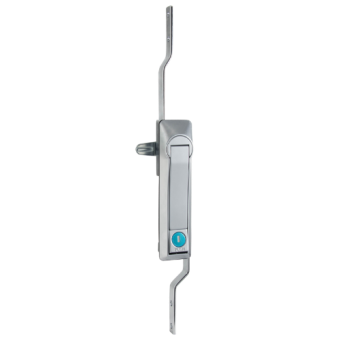
A professional-grade quarter-turn lock is a modular system. Understanding each part is the first step toward a secure cabinet.
- The Housing (The Body): This is the part that sits in the cabinet cutout. It houses the internal mechanism and is secured from the back by a nut.
- The Insert (The Driver/Plug): The part you interact with. It can be a tool-operated shape (like a triangle or double-bit) or a key-operated cylinder.
- The Cam (The Tongue): The metal plate that rotates 90° behind the cabinet frame to lock the door.
- The Gasket/O-Ring: Crucial for maintaining IP ratings by sealing the gap between the housing and the door.
2. Choosing the Right Material & Finish
The environment dictates the material. Choosing the wrong one can lead to "galvanic corrosion" or premature wear.
| Material | Best For | Pros/Cons |
|---|---|---|
| Zinc Die-Cast (Zamak) | Indoor/General Industrial | Pros: Cost-effective, high precision. Cons: Requires coating (Chrome/Black) to prevent oxidation. |
| Stainless Steel (304/316) | Marine, Food, & Chemical | Pros: Maximum corrosion resistance, high strength. Cons: Higher price point. |
| Polyamide (Plastic) | Lightweight/Telecommunications | Pros: Non-conductive, rust-proof, lightweight. Cons: Lower mechanical strength than metal. |
3. Understanding the "H-Dimension" (Grip Range)
The most common mistake in procurement is ordering the wrong cam. The H-Dimension is the distance from the front face of the door to the point where the cam contacts the cabinet frame.
To calculate the H-Dimension:
H = (Door Thickness) + (Gasket Compression) + (Distance to Frame)
Most cams are "cranked" (offset). Depending on how you install the cam, you can increase or decrease your grip range to ensure a snug, rattle-free fit.
4. Selecting the Insert Type (Security vs. Convenience)
Who needs access? This determines your driver type:
- Standard Tool Inserts (Triangle, Square, Double-Bit): Used where "authorized personnel only" is the requirement, but specialized security isn't needed.
- Key-Locking Cylinders: Necessary for public-facing cabinets (e.g., EV chargers, street lighting) where physical security is a priority.
- Vibration-Resistant Drivers: Specifically designed for the railway and transport sectors (meeting DIN EN 61373 standards). These feature an internal spring mechanism to prevent the lock from vibrating open.
5. When to Upgrade to a Compression Latch?
If your cabinet is in a high-vibration environment or requires an IP66/IP67 rating, a standard 1/4 turn might not be enough.
A Compression 1/4 Turn Lock performs two actions:
- It rotates 90° to the locking position.
- It pulls the cam 3mm to 6mm closer to the door, "compressing" the rubber gasket.
This ensures a 100% water-tight seal and eliminates door rattle.
6. Summary Checklist for Your Next Order
Before you hit "Order," verify these five points:
- Cutout Size: Is it the standard 22.2mm (20.2mm flat-to-flat)?
- Material: Does the environment require Stainless Steel?
- H-Dimension: Have you measured the grip range accurately?
- IP Rating: Does the lock come with a pre-installed gasket?
- Grounding: Do you need an earthing/grounding nut for electrical safety?
Need Technical Drawings?
HingeLocks provides full CAD models for all MS-series quarter-turn locks.



 German
  English
  Spanish
  French
  Japanese
  Arabic
  Korean
  Swedish
  Dutch
Dutch  Greek
Greek  Hindi
Hindi  Hebrew
  Italian
  Vietnamese
  Thai
Thai  Bulgarian
  Czech
Czech  Slovak
  Hungarian
  Finnish