
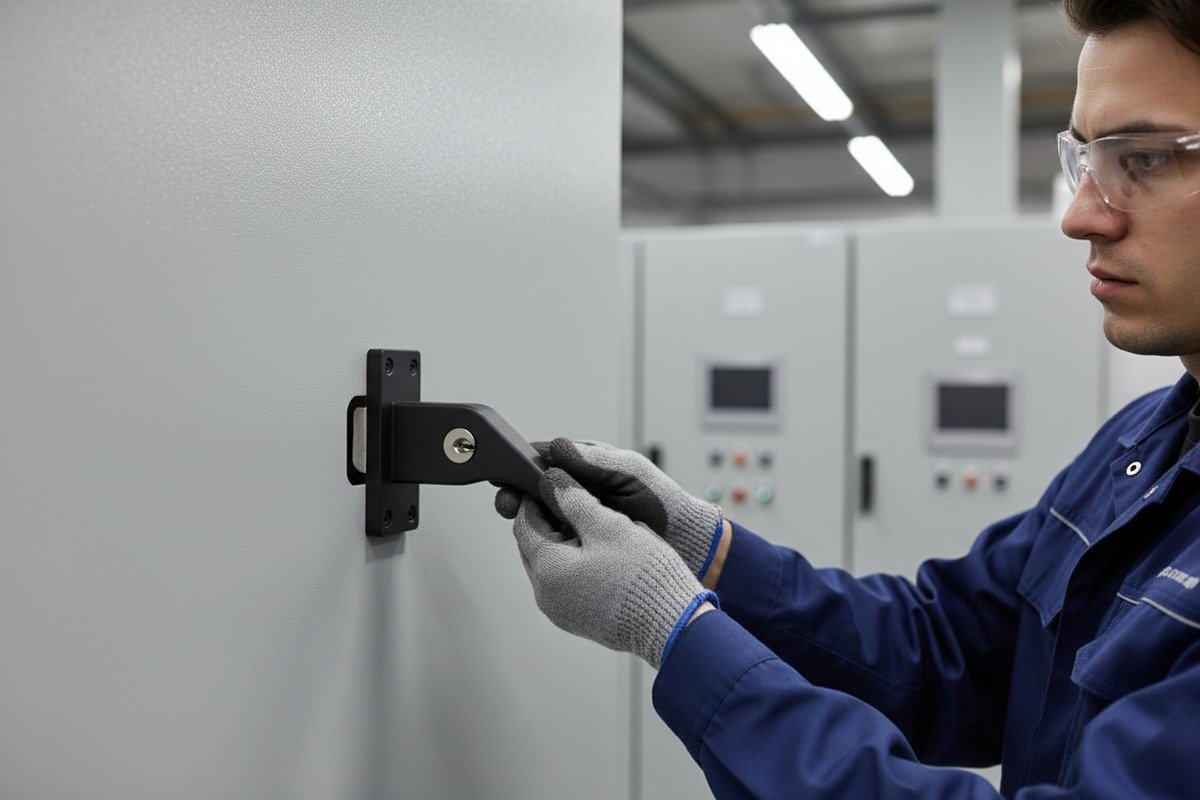
Getting the wrong cam latch for your electrical cabinet door is a costly mistake we see every week on our production floor. NEMA enclosure types 1 Doors that won't seal, latches that spin freely in oversized cutouts, or barrels too short to grip the panel — these problems stall entire assembly lines and risk failing IP66 certification 2. The frustration is real, and the fix starts with understanding how door thickness and panel cutouts work together.
To match a cam latch to your electrical cabinet, measure the door thickness to determine the correct grip range or barrel length, then verify the panel cutout dimensions match the latch housing diameter and shape. The cam offset and length must bridge the gap between the door and frame while maintaining seal compression.
This guide walks you through every measurement, standard, and decision point. We will cover tools, tables, common mistakes, and customization options so you can get it right the first time. Let's start with the most fundamental step: measuring your door.
How do I accurately measure my door thickness to find the right cam latch grip range?
One wrong measurement can cascade into weeks of delays. Our engineering team has seen customers order thousands of latches based on a spec sheet that didn't account for gasket compression 3 or paint layers.
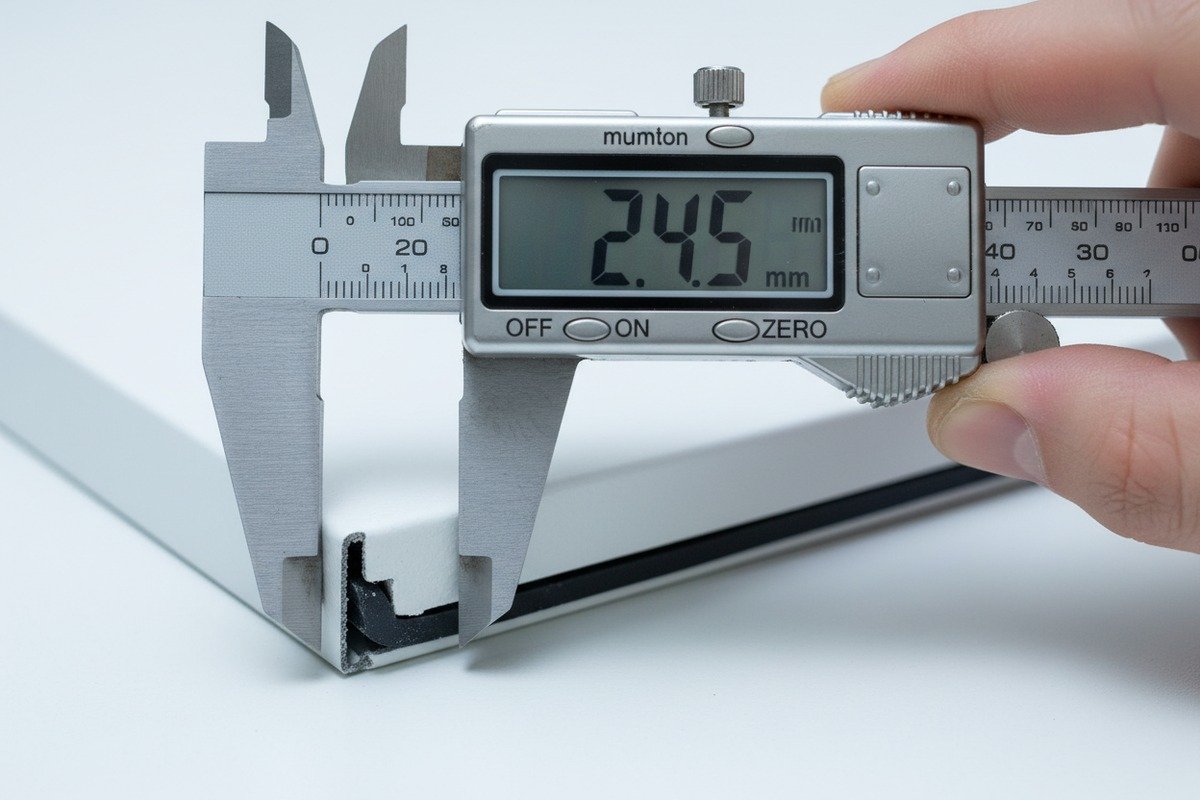
Use a digital caliper to measure your door's total thickness at the latch mounting point, including any gasket, paint, or liner. Then match that measurement to the cam latch's published grip range — the minimum and maximum panel thickness the barrel and locking nut can accommodate securely.
Why Total Thickness Matters More Than Nominal Thickness
Many engineers reference the nominal sheet metal gauge 4 — say, 1.5 mm or 2.0 mm cold-rolled steel. But the actual thickness at the mounting point is almost always different. Paint adds 0.05–0.15 mm per side. Powder coating can add up to 0.3 mm. If your cabinet uses an inner liner or insulation board, you might be dealing with a combined thickness of 4–6 mm instead of 2 mm.
When we design cam latches in our facility, the grip range is the specification that ties barrel length to door thickness. The grip range tells you the thinnest and thickest panel the latch can clamp. If your door is thinner than the minimum, the locking nut won't tighten properly. If it's thicker than the maximum, the barrel simply won't reach through.
Step-by-Step Measurement Process
- Open the cabinet door fully.
- Place one jaw of the digital caliper 5 on the outer surface of the door at the intended latch location.
- Place the other jaw on the inner surface.
- Record the reading to the nearest 0.1 mm.
- If a gasket or seal sits between the door and frame, measure it separately under light compression (about 30% deflection).
- Add the compressed gasket thickness to the door thickness. This is your effective grip thickness.
Common Cylinder Lengths and Their Grip Ranges
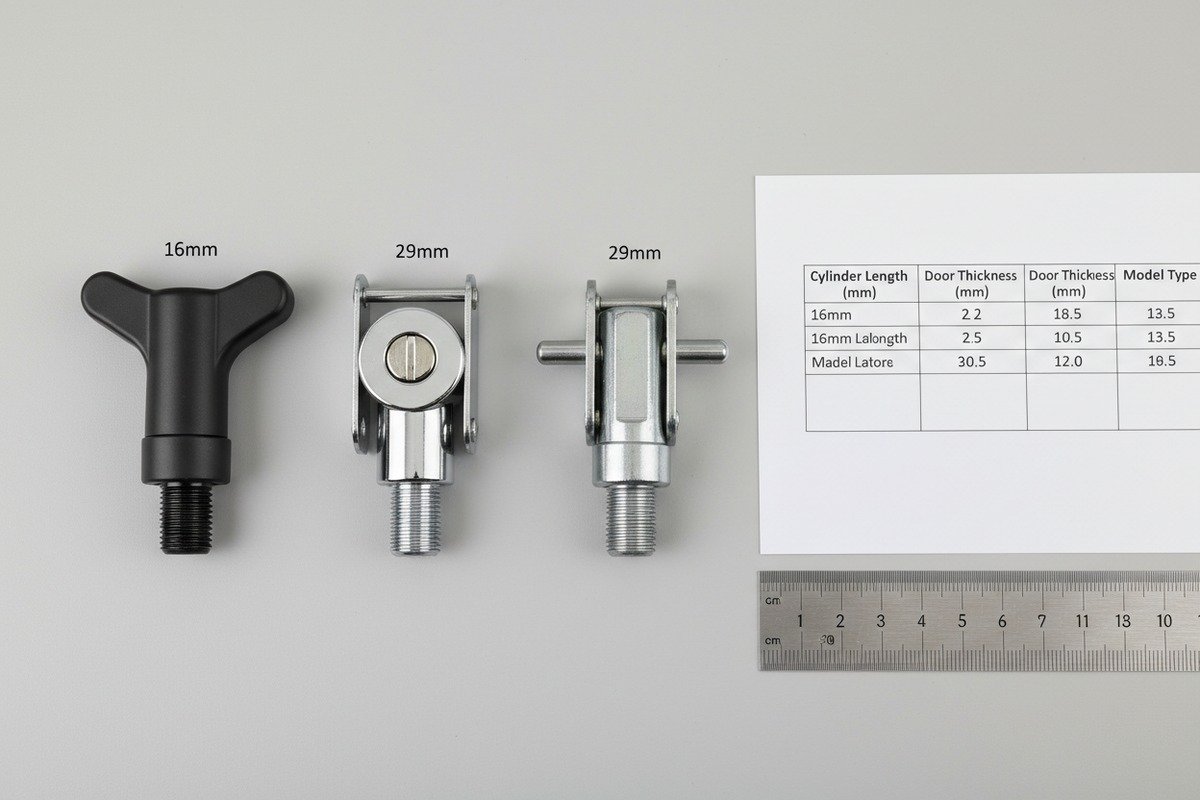
The table below shows standard relationships between cylinder length and maximum door thickness. These are widely used across the industry, and our own product lines follow similar conventions.
| Cylinder Length (inch) | Cylinder Length (mm) | Max Door Thickness (inch) | Max Door Thickness (mm) |
|---|---|---|---|
| 5/8" | 16 mm | 3/8" | 9.5 mm |
| 7/8" | 22 mm | 5/8" | 16 mm |
| 1-1/8" | 29 mm | 7/8" | 22 mm |
| 1-3/8" | 35 mm | 1-1/8" | 29 mm |
Notice the pattern: the maximum door thickness is typically the cylinder length minus roughly 6 mm. That 6 mm accounts for the latch head sitting on the outer surface and the nut engagement on the inner side.
A Quick Sanity Check
After you measure, compare your reading to the latch datasheet grip range. If your thickness falls in the middle of the range, you're in a good spot. If it's near the maximum, consider going one size up. Edge cases cause problems — especially in vibration-heavy environments where nuts can loosen over time.
Our quality control team always recommends leaving at least 1–2 mm of margin within the grip range. This buffer handles manufacturing tolerances in both the door and the latch barrel.
What are the standard panel cutout dimensions I should follow for my industrial cabinet?
Panel cutouts seem simple until you drill one at the wrong diameter and ruin a $200 stainless steel 6 door. Our CNC punching 7 stations produce thousands of cutouts daily, and even a 0.5 mm error creates problems downstream.
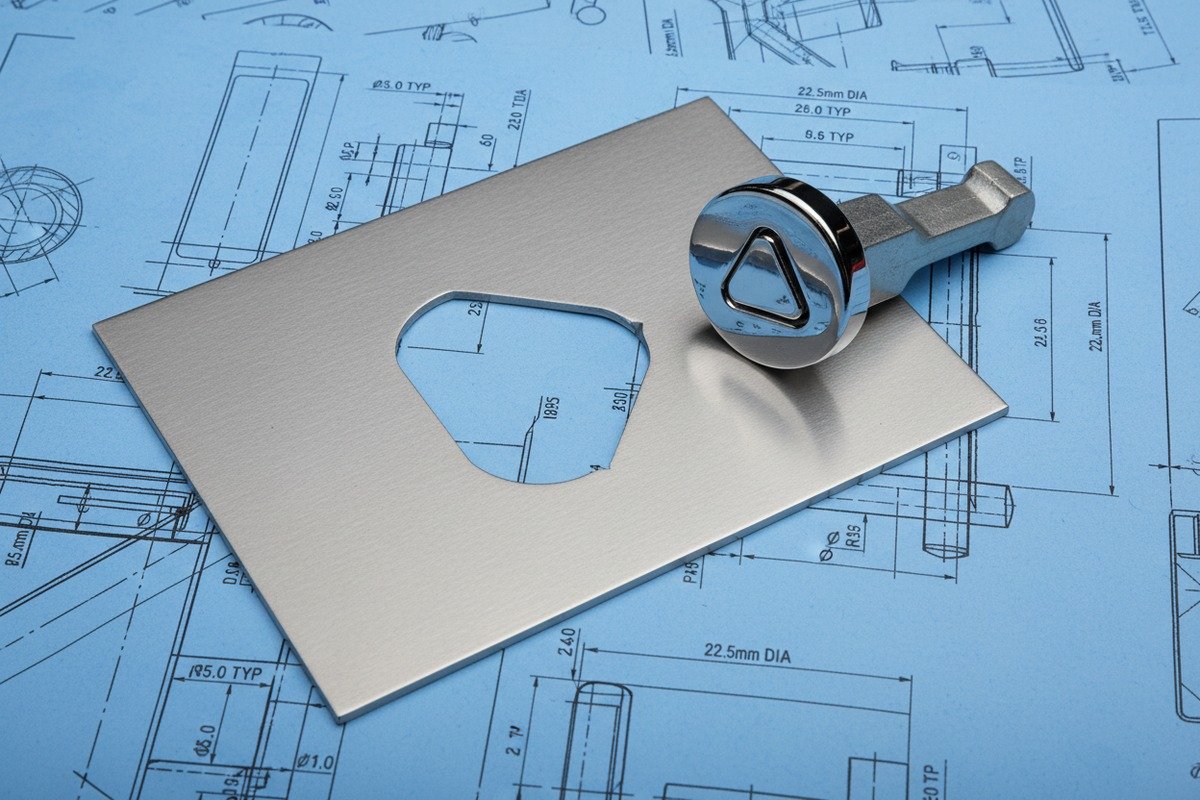
Standard panel cutouts for cam latches are typically circular or D-shaped, ranging from 16.5 mm to 22.5 mm in diameter. The exact dimensions depend on the latch series. Always follow the manufacturer's cutout template, which specifies diameter, flat width, and corner radii to prevent barrel rotation and ensure a secure fit.
Circular vs. D-Shaped Cutouts
Most cam latches for electrical cabinets use a threaded barrel with one or two flats. These flats require a D-shaped or double-D cutout in the panel. The flat prevents the barrel from rotating when you tighten the nut from inside. A purely circular hole would let the barrel spin, making installation impossible without a second pair of hands holding the outer body.
Some simpler cam locks — the kind used in furniture — do use round cutouts because they rely on friction or a separate anti-rotation washer. But for industrial electrical cabinets, you want the flat built into the cutout.
Standard Cutout Dimensions by Latch Type
Here's a reference table based on common cam latch families we produce and supply:
| Latch Type | Cutout Shape | Cutout Diameter (mm) | Flat Width (mm) | Recommended Tolerance |
|---|---|---|---|---|
| Quarter-turn cam latch (small) | D-shaped | 16.5 | 14.0 | ±0.2 mm |
| Quarter-turn cam latch (standard) | D-shaped | 22.5 | 19.0 | ±0.2 mm |
| Compression cam latch | D-shaped | 22.5 | 19.0 | ±0.3 mm |
| Swing handle latch | Rectangular | 92 × 36 mm | N/A | ±0.5 mm |
| Paddle latch (flush) | Rectangular | 89 × 34 mm | N/A | ±0.5 mm |
Getting the Tolerance Right
Too tight, and the barrel won't fit. Too loose, and you lose the anti-rotation function and may compromise the gasket seal. Our recommendation: use CNC punching or laser cutting 8 for cutouts. Manual hole saws work in a pinch, but they tend to produce slightly oversized or uneven holes. If you must use a step drill, go slowly and check frequently with a caliper.
Flat Orientation
The flat on the cutout should align with your desired latch orientation. Most quarter-turn latches lock at 90° rotation, so the flat determines whether the cam points up, down, left, or right when locked. Plan this before cutting. Rotating a D-shaped cutout after the fact means re-drilling and patching.
Edge Distance and Spacing
Don't place the cutout too close to the door edge. A minimum of 15 mm from the cutout edge to the panel edge is standard for 1.5 mm steel. For thinner panels, increase this to 20 mm. If you're installing multiple latches on a tall door (such as a 2-meter server cabinet), space them evenly and keep each cutout at least 100 mm from any bends or reinforcement ribs.
Can I customize my cam latch offset if my door thickness is non-standard?
Non-standard doors are more common than standard ones. We receive custom orders every week from clients building cabinets with double-wall insulation, composite panels, or thick fiberglass doors that don't fit any catalog barrel length.
Yes, cam latch offsets and barrel lengths can be customized for non-standard door thicknesses. Manufacturers like us offer extended barrels, adjustable cam arms, spacer kits, and fully bespoke cylinder lengths to match thicknesses outside the typical 9.5–29 mm range, ensuring secure clamping and proper cam engagement.
What "Offset" Really Means
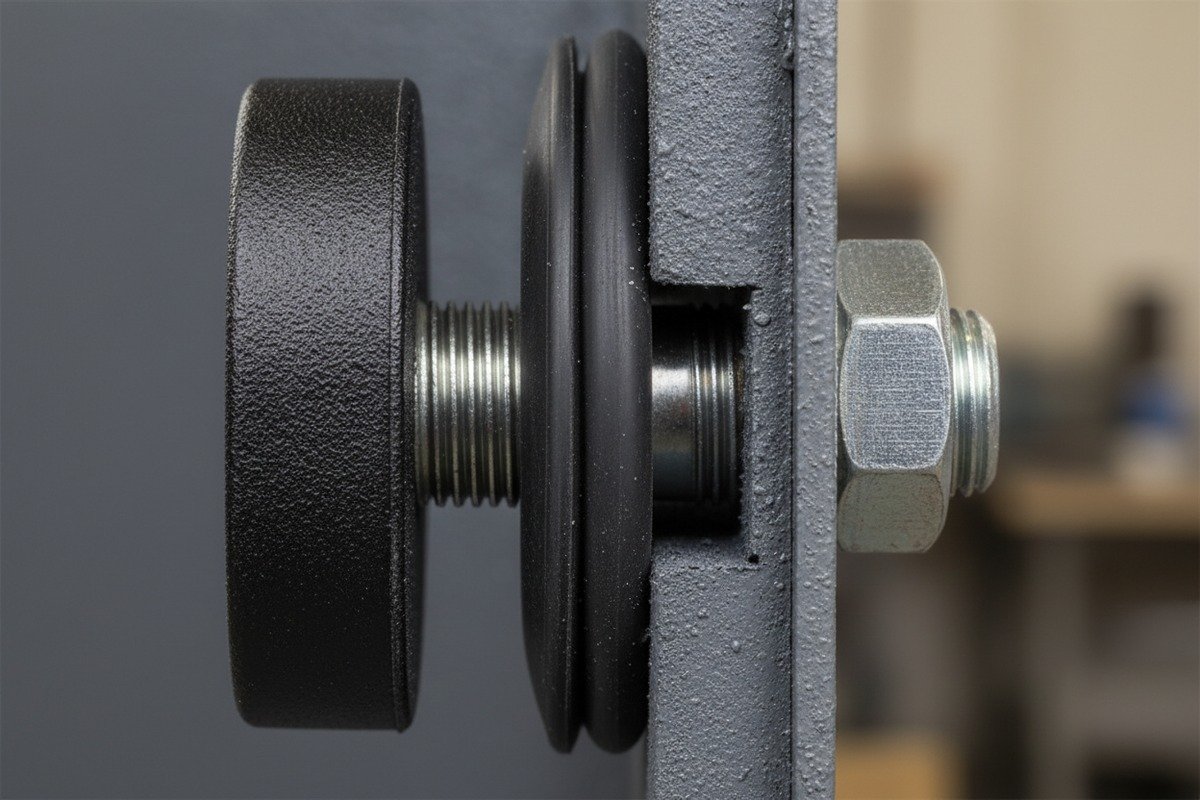
The cam offset is the distance between the cam's pivot axis (the barrel center) and the cam's contact edge. A straight cam has zero offset — it sweeps in a flat plane. A bent or formed cam has an offset that pushes the contact point closer to or farther from the door's inner surface. This offset determines how tightly the cam pulls the door against the frame or gasket.
For standard 1.5–2.0 mm steel doors, a cam with 3–5 mm offset works well. But if your door is 8 mm thick composite, you need a longer barrel and a cam with greater offset — perhaps 8–12 mm — so the cam can still reach the strike or keeper on the frame.
Customization Options We Offer
From our production line, here are the most common customization paths:
Extended barrel lengths. We can machine barrels from 16 mm up to 50 mm or longer. Each extended barrel comes with a matching longer threaded section and nut.
Adjustable cam arms. Some of our cam latch models accept interchangeable cams. You buy the body once and swap the cam for different applications. A dual-cam kit might include a straight cam for flush overlay doors and a formed cam for inset doors with gaskets.
Spacer kits. For slight mismatches (1–3 mm), a spacer ring behind the latch head can take up the slack without needing a different barrel.
Fully bespoke cylinders. For OEM customers ordering 500+ pieces, we can produce a custom cylinder length to the nearest 0.5 mm. This is common for EV charger enclosures and energy storage cabinets with thick composite walls.
When to Choose Adjustable vs. Fixed
Adjustable cam latches cost slightly more upfront but save money if you manage multiple cabinet models with different door thicknesses. Fixed-length latches are cheaper per unit and ideal when your production is high-volume with a single door spec.
The Cam Flip Technique
Here's a trick our technical team shares with customers: many cams can be flipped 180° on the barrel. A cam designed for a flush overlay door (cam formed away from you) becomes an inset-door cam (cam formed toward you) simply by flipping it. This effectively doubles the application range of a single cam latch model. However, flipping doesn't change the barrel length — it only adjusts the cam's working direction.
Material Considerations for Custom Latches
Custom latches for thick doors often go into harsh environments. If the door is thick because of insulation for outdoor use, the latch probably needs stainless steel (304 or 316) for corrosion resistance 9. Our zinc alloy latches work well for indoor panels up to 50 kg load, but outdoor or marine-grade applications demand stainless.
| Customization Type | Best For | Typical Lead Time | MOQ at Hingelocks |
|---|---|---|---|
| Extended barrel | Thick composite/insulated doors | 15–20 days | 200 pcs |
| Adjustable cam kit | Multi-model cabinet lines | 10–15 days | 100 sets |
| Spacer ring | Minor thickness mismatches (1–3 mm) | 5–7 days | 500 pcs |
| Fully bespoke cylinder | OEM projects, single spec | 25–35 days | 500 pcs |
How do I ensure my panel cutout doesn't compromise the IP66 rating of my cabinet?
An IP66 rating means your cabinet can withstand powerful water jets and complete dust ingress protection. One poorly sealed cutout can void the entire rating. Our testing lab runs IP66 validation on every new latch design, and the cutout interface is always the weakest link if not done correctly.
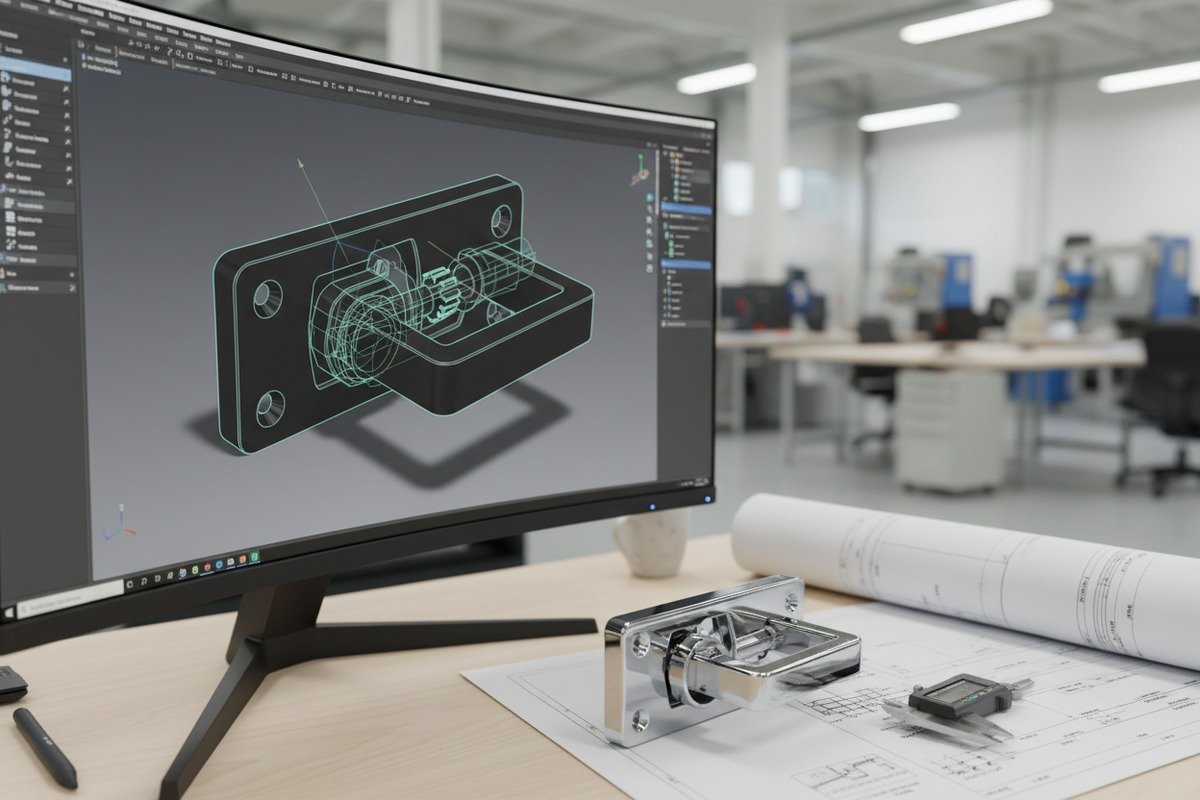
To maintain IP66 integrity at the panel cutout, use a cam latch with an integrated gasket or sealing flange that fully covers the cutout perimeter. The latch must compress the gasket evenly when locked, and the cutout must be clean-edged with no burrs, oversizing, or cracks that could create leak paths.
How the Seal Actually Works
Most IP-rated cam latches use a molded rubber or silicone gasket sandwiched between the latch body flange and the outer surface of the door. When the locking nut is tightened from inside, it compresses this gasket against the panel. The gasket must cover the entire cutout perimeter with no gaps.
The gasket compression should be 25–35% of its free height. Under-compression leaves gaps. Over-compression crushes the gasket and causes it to permanently deform, losing elasticity over time.
Cutout Quality Standards
A clean cutout is non-negotiable for IP66. Here's what to check:
- No burrs. Burrs on the cutout edge create tiny channels where water can wick through. Deburr every hole after punching or drilling.
- No oversizing. If the cutout is even 1 mm too large, the gasket may not bridge the gap. Stick to the manufacturer's template.
- No cracks. Hairline cracks radiating from the cutout are common in thin or brittle panels. Inspect after punching, especially in aluminum.
- Flat surface. The area around the cutout must be flat for the gasket to seat evenly. Dents, welds, or paint drips under the flange will create leak paths.
Latch Features That Support IP66
Not all cam latches are designed for sealed applications. When specifying for IP66, look for these features:
- Integrated gasket flange — wider than the cutout by at least 3 mm on all sides.
- Compression cam mechanism — pulls the door tightly against the frame gasket (separate from the latch-to-panel gasket).
- Stainless steel or corrosion-resistant body — rust around the cutout eventually undermines the seal.
- Captive gasket — bonded to the flange so it can't fall off during installation.
Testing After Installation
Even with perfect components and cutouts, test the final assembly. Our quality protocol includes a simple hose test at 12.5 liters per minute from 3 meters distance for 3 minutes per face. If you see any moisture inside, the latch-to-panel interface is the first place to check.
For dust, look for fine powder ingress after vibration testing. Dust typically enters through gaps the eye can't see.
Environmental and Thermal Considerations
In outdoor installations — telecom base stations, EV chargers, solar inverter cabinets — temperature swings cause both the panel and the gasket to expand and contract. A steel panel might grow 0.1 mm per 10°C rise across a 200 mm span. The gasket must remain compliant across the full temperature range, typically -40°C to +80°C. Silicone gaskets handle this better than EPDM in extreme cold, while EPDM is more UV-resistant.
Our R&D team has found that using a compression latch (rather than a simple quarter-turn) gives more consistent gasket loading across temperature cycles. The compression mechanism applies a defined force rather than relying on a fixed cam position, so it compensates naturally for thermal expansion 10.
Conclusion
Matching cam latches to your cabinet starts with precise measurements, follows through with correct cutout standards, and ends with verified seal integrity. Every millimeter matters. If your door thickness or application falls outside the standard range, customization is always an option — reach out to our team at sales@hingelocks.com for technical support.
Footnotes
- Wikipedia page detailing various NEMA enclosure types and their definitions. ↩︎
- Explains IP ratings, including IP66, from an authoritative industry association. ↩︎
- Discusses optimal gasket compression percentages for effective sealing in industrial applications. ↩︎
- Offers a comprehensive sheet metal gauge chart and explanation for engineering reference. ↩︎
- Provides a guide on how to accurately use a digital caliper from a reputable manufacturer. ↩︎
- Comprehensive explanation of stainless steel, its composition, properties, and uses. ↩︎
- Wikipedia page covering CNC punching within the broader topic of punching machines. ↩︎
- Explains laser cutting technology, its process, and industrial applications from a research organization. ↩︎
- Defines corrosion resistance and its importance from a professional corrosion engineering organization. ↩︎
- Explains the concept of thermal expansion and provides coefficients for various materials. ↩︎







 Hindi
Hindi  English
  Spanish
  French
  German
  Japanese
  Arabic
  Korean
  Swedish
  Dutch
Dutch  Greek
Greek  Hebrew
  Italian
  Vietnamese
  Thai
Thai  Bulgarian
  Czech
Czech  Slovak
  Hungarian
  Finnish